

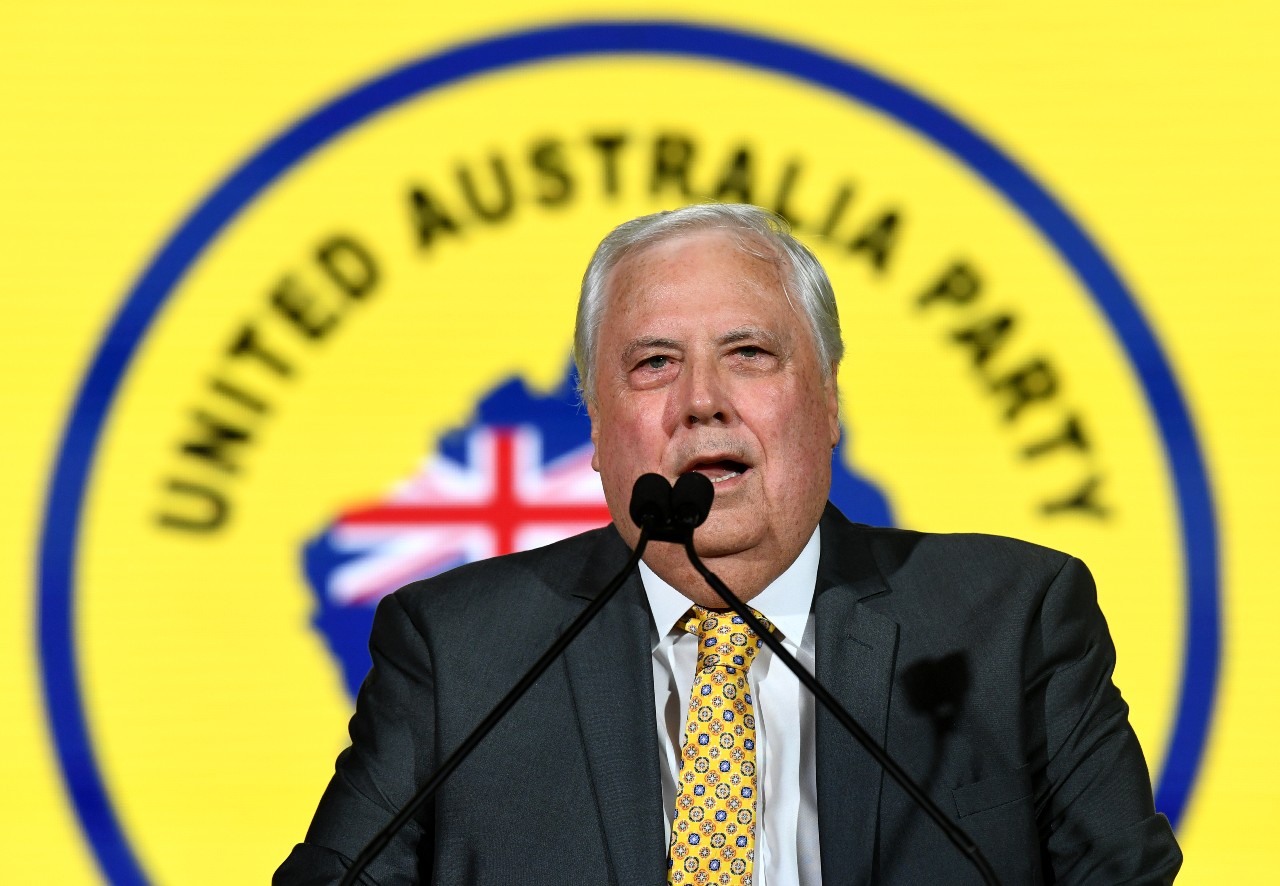
Mining billionaire Clive Palmer has lost a last-minute Federal Court bid to have ticks not counted as yes votes in this weekend’s voice referendum.
It comes after the court dismissed an earlier effort by United Australia Party senator Ralph Babet and Mr Palmer, who is chairman of the party, to have ‘X’ votes counted as a ‘no’.
An appeal over the decision was dismissed by three Federal Court judges following an all-day hearing in Sydney on Monday.
Barrister Luke Livingston SC argued ticks should not be counted as a formal response to the ballot, but if they are a cross should be similarly recognised.
“If the court concludes that the intention to vote ‘yes’ is the only plausible explanation for the use of a tick, we say it would follow that an intention to vote ‘no’ is the only plausible explanation for the use of a cross,” he said.
Mr Palmer is the owner of the Palmer Coolum Resort, which is currently undergoing refurbishment, and former Federal Member for Fairfax, a seat now held by the LNP’s Ted O’Brien.
Official instructions for the referendum are to clearly write either ‘yes’ or ‘no’ in the ballot box, however, the Australian Electoral Commission says a tick will also be counted as ‘yes’, as has been the case for the past six referendums.
Related story: Clive Palmer-owned company to sue government
“The legal advice provides that for a single referendum question, a clear ‘tick’ should be counted as formal and a ‘cross’ should not,” the AEC said in August.
Mr Livingston argued there was a plausible case for a tick to constitute a “non-response” to the ballot question.
“This is a short ballot paper, it has very few words, and they’re very clearly expressed,” he said.
“For somebody to put a tick on such a ballot paper that so plainly asks for yes or no, is we say plausibly explained by the voter not reading and not understanding the ballot paper.”
Mr Livingston also argued in a system of compulsory voting, a tick may be taken as someone literally treating it as a “tick-the-box exercise” and should in that case also be taken as a non-response.
“No one can say with sufficient certainty that a tick … conveyed with unmistakable clarity the voter’s intention to vote yes,” he said.
Barrister for the AEC Stephen Free SC argued common sense should be applied to determining a voter’s intention in cases where it is not certain, and a tick can be reliably understood as a response in the affirmative.
“The significance of a tick is that it does have an accepted symbolic meaning which is inherently affirmative,” he said.
“To tick this box in response to that question is to record a positive response.”
Related story: Clive Palmer renews bid for mega car museum
Mr Free said conversely, crosses have a more ambiguous meaning and are commonly used in forms to indicate agreement, as well as historically in ballots to signify positive preference.
“There’s a long history in this country – including in an electoral context – of crosses being used in an affirmative selection way,” he said.
Mr Free noted while there will inevitably be some ballots marked with either a tick or a cross, it will almost certainly be a “marginal issue”, with less than 1 per cent of votes counted as informal in the last referendum.
“The instructions are clear, but there is all this noise in the community about ticks and crosses which may have translated, perversely, into a misunderstanding on people’s part about what the instructions actually are,” he said.
The October 14 referendum ballot will present a proposed law to alter the constitution “to recognise the first peoples of Australia by establishing an Aboriginal and Torres Strait Islander voice”.
Voters will be asked: “Do you approve of this proposed alteration?”
Senator Babet has said he will vote ‘no’ in the referendum and as recently as August endorsed UAP material asking misleading questions including whether the Voice will, “take Australia from its citizens”.
Do you have an opinion to share? Submit a Letter to the Editor at Sunshine Coast News via news@sunshinecoastnews.com.au. You must include your name and suburb.