
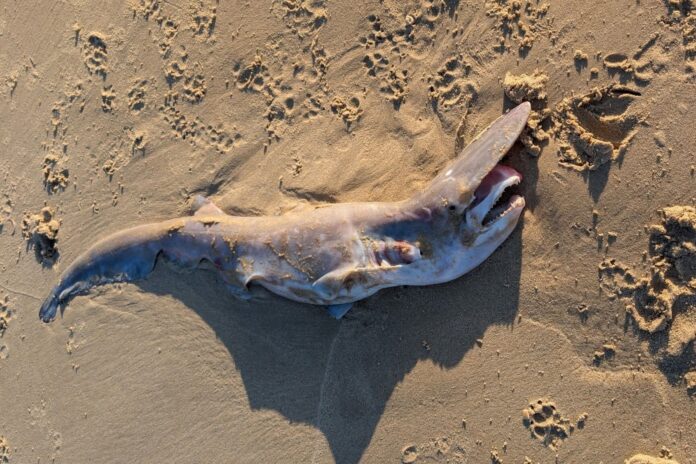
A deep-sea shark that washed up at a popular Sunshine Coast dog beach is believed to be the first known record of the rare species in the northern half of Australia.
The deceased goblin shark was found just north of the Stumers Creek mouth at Coolum on Thursday, with Queensland Museum and University of the Sunshine Coast (UniSC) alerted to the discovery.
Queensland Museum ichthyologist Dr Jeff Johnson confirmed from photographs that the Coolum shark was a goblin variety, which are usually found along the sea floor in depths of around 1000m.
In addition, he said it was well outside its known Australian range.
In Australia, the species has previously been recorded off New South Wales, Tasmania and possibly South Australia but, even then, sightings are rare.
Dr Asia Haines, Research Fellow, School of Science, Technology and Engineering at UniSC told SCN her colleague, Dr Bonnie Holmes, senior lecturer in Animal Ecology at UniSC, had confirmed it was likely the first record of a goblin shark in Queensland waters.
Goblin sharks, which belong to a lineage dating back about 125 million years, are so elusive that footage of live specimens in their natural deep-sea habitat made worldwide headlines in June.
The footage formed part of a study published in the Journal of Fish Biology in May, documenting two live observations in the central Pacific: one near Jarvis Island in 2019 and another on the slope of the Tonga Trench in 2024.
Resident Philip Dunbavan said he photographed the animal after another beach walker spotted the strange creature on the sand.
He said he knew it was a shark, but had “no idea” what kind it was.
“It was a weird looking creature. I’ve never seen anything like it,” Mr Dunbavan said.
“I posted it on iNaturalist to find out what it is and a whole heap of people got back to me and confirmed it was a goblin shark.”
Mr Dunbavan said Queensland Museum later saw the iNaturalist post and tried to contact him.
It was Federal resident and keen fisherman David Nash who took the specimen home for preservation after spotting it while walking his dogs with sons, Hunter and Harry, at Stumers.
“We were on the northern side of the creek: it looked like someone had dragged it up high,” Mr Nash said.
“I knew what it was and thought more about it and realised how rare it was and figured we could put it in the fridge in the back of my car. I contacted the uni to see if they could use it for research purposes, and they said they would be picking it up today (Friday).
“My son Hunter slung it over his shoulder and walked it back to the car, and we got it home and put it in the freezer as per their instructions. It’s a juvenile, so it fit in my chest freezer.”
Dr Johnson applauded the combined efforts of Coast locals to preserve the rare find, and gave insight into what will happen to the shark.
“I’d like to thank David Nash, Dr Bonnie Holmes and the UniSC for their cooperation,” he said.
“The uni is going to conduct research on the specimen and find out why it died, and when they finish their research, they’re going to pass it on to me at the museum for permanent storage. It’s great that we’re going to get the most out of this specimen and advance the understanding of it.”
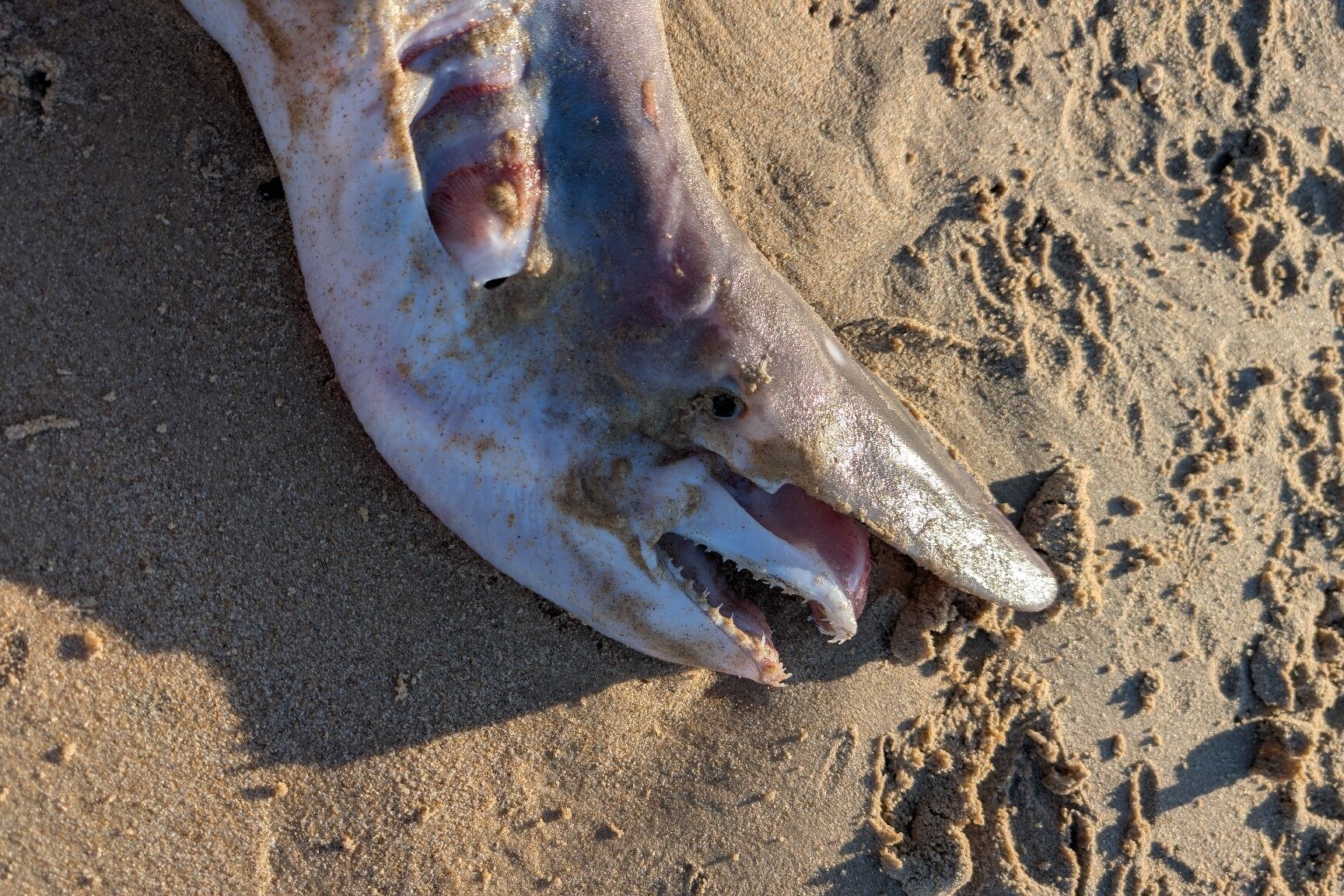
Goblin sharks are one of the world’s most unusual-looking sharks, with a long flattened snout and jaws that can extend from the mouth to seize prey.
Despite their striking appearance, Dr Johnson said goblin sharks were not considered a threat to beachgoers.
“They don’t occur in depths that people would be,” he said.
“It’s probably been sick and sort of drifted in from out much deeper, just washed up on the shore,” he said.
Like stories that inform, connect and celebrate the Sunshine Coast? So do we. Join an independent local news revolution by subscribing to our FREE daily news feed at the bottom of this article.
Dr Johnson estimated the shark was about 1.5m long from photographs, although the species can grow to about 3.9m.
He said it was not unusual for deep-water fish to occasionally wash ashore, although they were often eaten before they could be found or collected.
He said there were goblin shark specimens in the Australian Museum collection and in CSIRO’s collection in Hobart, but Queensland Museum did not have one.