
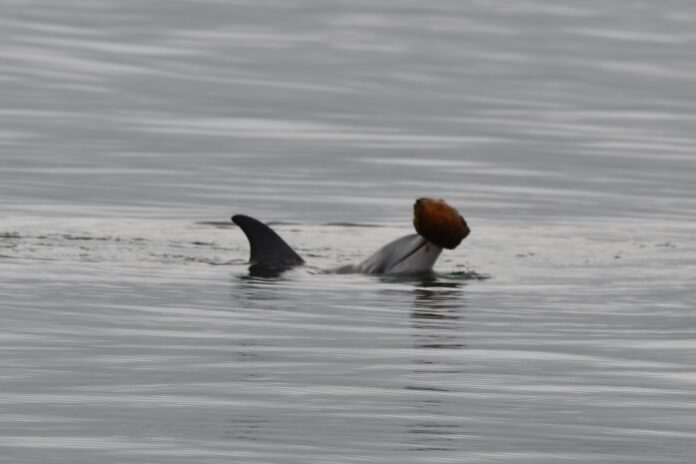
Sunshine Coast researchers have captured footage of dolphins using seashells to catch fish off Queensland’s coast.
A University of the Sunshine Coast team recorded two sightings of bottlenose dolphins engaging in the tool use behaviour, called shelling, at the Great Sandy Marine Park off Hervey Bay between July and October in 2025.
Animal behaviouralist and marine mammal expert Dr Alexis Levengood said the only previous published evidence of the rare and fleeting behaviour had been among a species of dolphin at Shark Bay in Western Australia.
“We were on a research boat off Hervey Bay when we spotted a dolphin raising something large out of the water. I started screaming because I know what shelling looks like,” Dr Levengood, the study’s lead author, said.
“It’s a hunting behaviour where dolphins chase fish into large empty shells, bring the shell to the surface and then shake it to drain the fish into their mouths.
“We were able to record footage and take photographs of dolphins shelling in the Great Sandy Marine Park, which is the first published record of it on the east coast of Australia.”
For more local news videos SUBSCRIBE to our YouTube channel. Just click here.
During one sighting, an adult female dolphin and calf were observed shelling, which indicated the calf might have learned the skill from watching its mother.
“We saw the mother surface with a shell, the fish inside escaped and the dolphin dropped the shell to chase the fish. Then, minutes afterwards, the dolphin calf picked up the shell and held it the same way as its mother,” she said.
“Our footage provides the first potential evidence of maternal social transmission: a process by which offspring learn behaviour by observing the actions of its mother. It challenges the belief that dolphins learn this tool use from their peers.
“These findings highlight how smart, clever and innovative dolphins are.”
She said further research was needed to understand the nuances of shelling and to provide clarity on transmission pathways and links to ecology, cognition, culture and evolution.
“We learned shelling had been photographed during boat trips run by Blue Dolphin Marine Tours during 2013 and 2019, indicating shelling has occurred in this population for longer than expected, but went unnoticed due to limited research in the region,” she said.
“Our observations in Queensland show that dolphins on opposites sides of Australia have learned to use tools in the exact same way, independent of one another.
“There’s still a lot we don’t know and many questions we will hopefully ask and answer with time. But better understanding shelling, and other tool use in non-human animals, will continue to teach us more about ourselves and how and why we evolved the way we did.”
The study has been published in a paper in the journal of Marine Mammal Science.