
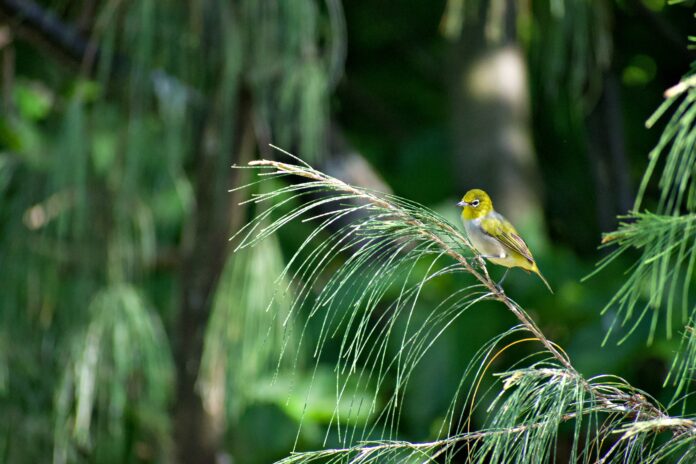
Island life appears to shape more than just people, with new research suggesting even tiny songbirds develop their own way of sounding when cut off from the mainland.
A study from the University of the Sunshine Coast found silvereyes living on islands off Queensland have formed distinct vocal “cultures”, with songs that differ markedly from their mainland counterparts.
Researchers say the birds may even have their own version of musical genres.
The study compared four populations across southeast Queensland – two on the mainland at the Sunshine Coast and Fraser Coast, and two offshore on Heron Island and Lady Elliot Island.
Despite the island populations being more than 100 kilometres apart, their songs were found to be more similar to each other than to birds living on the nearby mainland.
Associate Professor Dominique Potvin said the findings were surprising.
“We expected that geography and genetics would explain differences in dialect, but they didn’t,” Dr Potvin said.
“Instead, these island birds have developed their own shared song culture, independent of distance, ancestry or how long the populations have been isolated.”

Led by UniSC Honours graduate Marie Robert, the research found island birds tended to produce higher-pitched songs with longer syllables and a broader range of sounds.
Related story: Study reveals birds’ ‘extraordinary’ efforts to find a mate.
Their vocal patterns also diverged in ways that could not be explained by genetic relatedness or how far apart the birds lived.
“Birdsong is socially learned, so it can change much faster than DNA,” Dr Potvin said.
The results mirror patterns seen in human language, where communities separated by geography often develop their own dialects over time.
Help keep independent and fair Sunshine Coast news coming by subscribing to our FREE daily news feed. All it requires is your email at the bottom of this article.
Researchers said the findings highlighted how animals, like people, can develop shared cultural traits within groups.
“In a previous study, we found that silvereyes in the country had a different style of song to their city-dwelling relatives,” Dr Potvin said.
“It’s a reminder that animals have cultural traditions too – these silvereyes are essentially composing their own soundtracks reflective of their community.”
The work forms part of the Leaf to Reef initiative, a broader research program examining biodiversity on Lady Elliot Island and its connection to the wider Great Barrier Reef.