
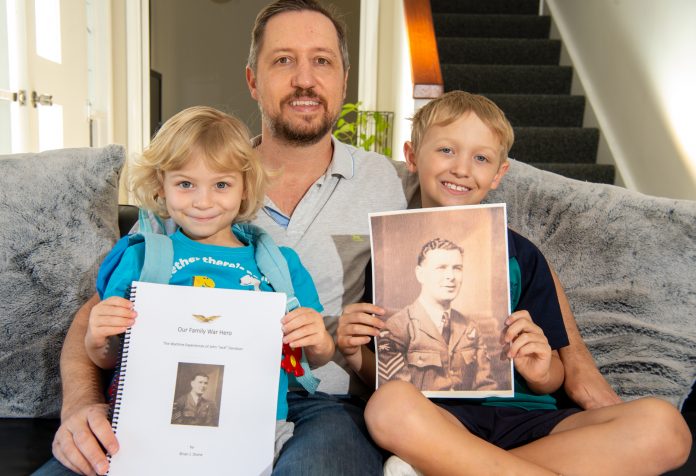
An incredible untold war story of survival, bravery and devotion will today be presented to the Caloundra Air Museum by a very proud Sunshine Coast family.
If you want to know what tough is, try existing on boiled vegetable peel. If you want to know what stoic is, try convincing your wife you will be home for Christmas when you are a prisoner of war. If you want to know what love is, try believing your husband is alive when everyone says he is dead.
John “Jack” Davidson (pictured below) was the only survivor when the plane he was aboard was shot down on one of the many high-risk Pathfinder missions flown by the Royal Air Force over Germany during World War II.
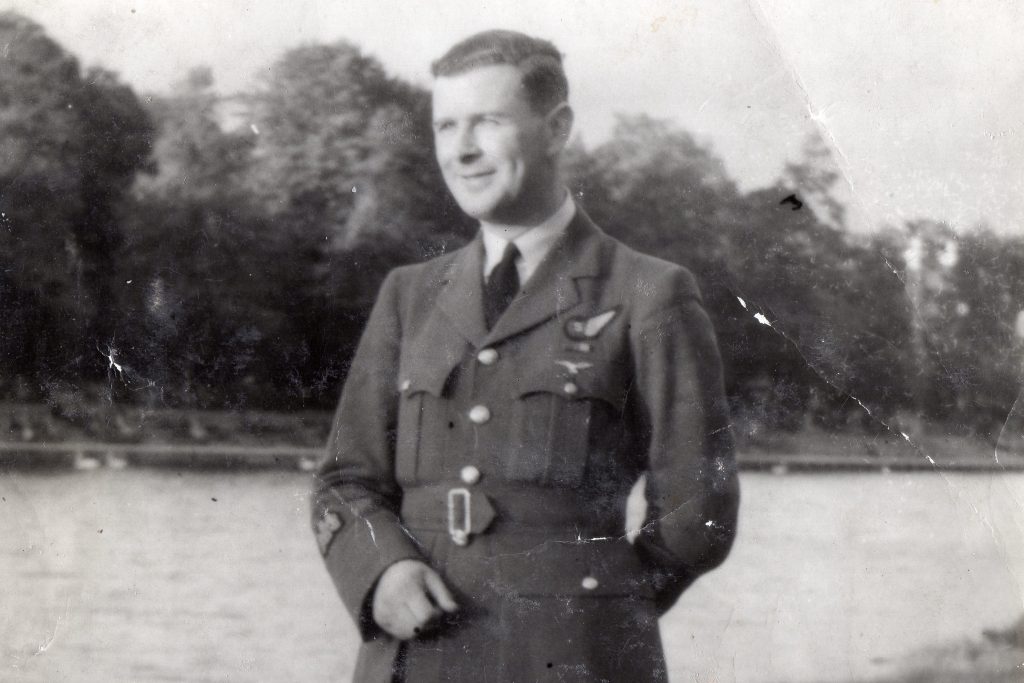
He jumped from the stricken aircraft and despite his parachute catching fire, he hit the ground alive, but bearing significant injuries.
Jack was handed over by a civilian to German soldiers and became a prisoner of war for almost two years.
His story has been documented by his son-in-law, Brian Stone, and Brian’s son, Richard Stone, of Mountain Creek, will hand over the memoir, titled Our Family War Hero, to the Queensland Air Museum on Friday with his own boys, Leo, 8, and Isaac, 4.
The museum at Caloundra has a Pathfinder section and is located on Pathfinder Drive so the family thought it appropriate that Jack’s story is kept there.
The book outlines how Jack, a railway clerk and young father of one in his early 30s, joined up to do his bit for the British war effort in 1940, trained as a wireless operator, and volunteered for the Path Finder Force, which flew ahead of bombers at night laying a trail of flares to guide them to their targets.
The Pathfinders suffered heavy losses and on Jack’s sixth operational flight in May 1943, the plane he was aboard was shot down.
His wife, Jean, received a telegram stating that he was missing and letters from the squadron commander and group captain expressed their regret.
Brian writes that Jean refused to believe Jack was dead and wrote to the mother of another missing solder: “I simply can’t cry. I just go about in a dream on my own not in company, one would not believe I had such a load in my heart. Jack will I’m sure come back to us some day.”
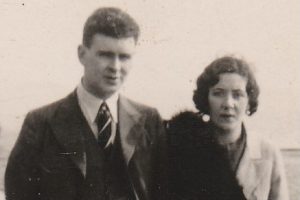
Seven weeks after he was reported missing, Jean received a letter from Jack, who had parachuted to the ground as the burning plane disintegrated and was in a German military hospital before being transferred to Stalag prison camps.
“Have just discovered how lucky I was as I am the only member of the crew alive, the rest unfortunately all being killed and I was most sorry when I got the news,” it read.
Their relationship was conducted by correspondence for the best part of the next two years.
Jack learned of the birth of their second child, Elizabeth, in a letter that managed to get through from Jean.
“I have just received your second letter and was delighted to hear you got your wish – a daughter and that you are both well. The name sounds swell and you have made quite a good job of it,” he replied.
As the Russian army advanced from the east, Brian’s book outlines how rations were reduced to boiled swede peel, how the soldiers were marched from Stalag 6 in Germany to Stalag 357 in Poland past angry locals who threw things at them.
The allied forces entered Germany from the west in March, 1945, and Jack was finally freed at the end of April, just before Germany’s surrender.
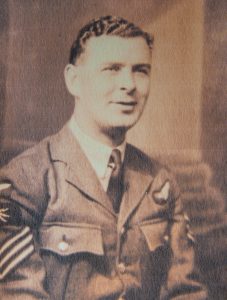
He and Jean went on to have two more children, including Richard’s mother, Rita.
Richard was too young to have ever known Jack, who died of a heart attack in the 1970s, but is in awe of his grandfather and men like him.
“I’ve read my Dad’s book a few times. The first time I read it, I was enthralled,” he said.
“Hearing their story, you get a feel for what they were really going through then, and that’s why my dad wrote it.”
Twenty years ago, Richard moved to Australia, settling on the Sunshine Coast.
Ian Campbell, an historian and author who volunteers at the Queensland Air Museum, said the Path Finder Force was the elite group in Bomber Command in World War II, given the difficult and dangerous task of flying ahead of the main force of bombers to mark and illuminate the targets.
Mr Campbell said they were always prime targets for the German defences, especially the Luftwaffe’s night fighters. Pathfinder crews were all volunteers. They were selected on performance and had to maintain the highest standards to keep their place in the PFF.
“On Jack Davidson’s Halifax bomber there were seven crew – pilot, flight engineer, navigator, air bomber, wireless operator, mid-upper gunner and rear gunner. Jack was the wireless operator, charged with handling all communications between the bomber and those orchestrating the attack back in England.
“These communications might be about the route, the weather, the German defences or aspects of conducting the attack itself. He would pass this information to the pilot and navigator. He was also trained as a gunner should he be needed to fill in for one of his mates.”
Mr Campbell said Our Family War Hero had some accounts of the operations Jack flew on.
He said where this memoir had particular significance and value was the account of his time as a POW after he was shot down over Germany.
“We learn about life in a POW camp, but it is the letters between Jack and his wife, Jean, during that period which set this memoir apart. Not only do so many letters survive, they expose the very great pressures both were under during their long period of separation. Brian Stone, who compiled his father-in-law’s memoirs, is very brave in allowing the reader to see the letters in their raw uncensored state.”
The Queensland Air Museum has the largest collection of planes in Australia, including the famed General Dynamics F-111. It is open daily from 10am to 4pm except Christmas Day. Keep an eye on the website for Open Days when the museum opens up various aircraft to the public. Information: qam.com.au