
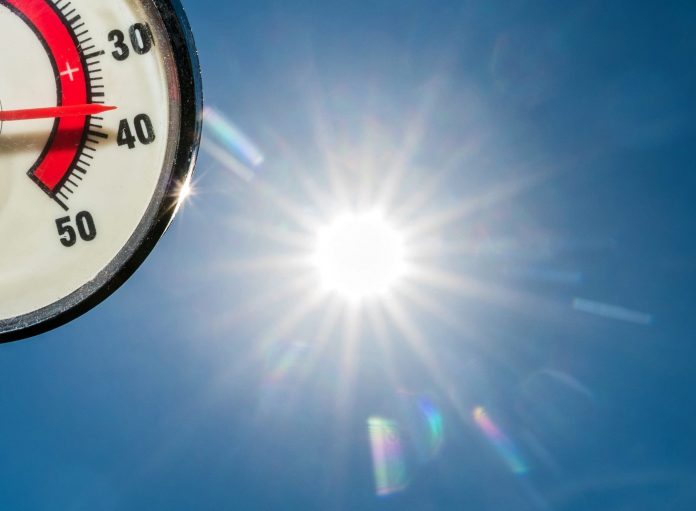
Babies being born in northern Australia in 2022 could face dangerous heat most days of the year by the time they are in their 70s, a new study warns.
Researchers from Harvard University and the University of Washington have projected billions of people in the world’s tropical and sub-tropical regions could be contending with dangerously high heat, the majority of the time, by 2100.
For Australia that means a life of sustained heat stress in roughly the northern half of the country, 78 years from now.
The southern half will fare slightly better but is still projected to experience far more heat waves. They could even become annual events.
Even if the world succeeds in limiting warming to 2C, exposure to dangerous heat is expected to increase by 50 to 100 per cent across much of the tropics, and by a factor of three to 10 in many mid-latitude regions like southern Australia.
“Heat waves that have been deadly in the past will become much more likely, and in some cases annual occurrence, in parts – most of Australia – even in a 2C world,” said Harvard climate scientist and study author Lucas Vargas Zeppetello.
“If we bypass the Paris agreement goals and, for example, end up with 3C of global warming by the end of the century, parts of northern Australia will likely experience heat waves that are without precedent basically anywhere in the world, almost every single year.
“It will almost certainly require very serious adaptation measures for people who live in these places.”

Simon Bradshaw, the research director of the Climate Council in Australia, says the world is currently on a trajectory to about 3C of warming, but there is still time to limit the pain locked in for future generations.
But it will take aggressive action within 10 years.
“Unfortunately sea levels will continue to rise for centuries or millennia,” he says.
“But when it comes to extreme heat, if we get emissions plummeting this decade, then as early as 2040 we’d start to see fewer deadly heat waves than we’d otherwise see. It really drives home the gravity of the actions we take now.”
Arnagretta Hunter is a cardiologist and physician with the Australian National University’s medical school, and has a particular interest in the health consequences of climate change.
“Climate change is the greatest health challenge we will face this decade. It has already impacted the lives of (about) 50 per cent of our Australian population through Black Summer and the recent catastrophic floods,” she said.
“It is time to use our scientific understanding of the relationship between the environment and human health, coupled with imagining the increase in extremes that are likely over the coming decades. This combination of science and imagination is key to climate adaption.”
The same study also said the world had just a 0.1 per cent chance of reaching the Paris climate pact’s aspirational target of keeping warming to 1.5C.
Dr Bradshaw agreed the chances are slim, but said with very aggressive action this decade, the kind that would really stretch the world, warming could still be limited to 1.5C over the long term.
“We’d go above that for a period but we could, by the end of the century, limit things to the low 1.5 degrees,” he said.
“What this study does show, unequivocally, is that every fraction of a degree of additional warming matters, and is measured in ever increasing threats to life and security.”
Help us deliver more news by registering for our free daily news feed. All it requires is your name and email. See SUBSCRIBE at the top of this article.