

Essential workers are increasingly being priced out of the Sunshine Coast rental market, with fewer than one per cent of available properties affordable for every occupation surveyed in new research.
Anglicare Australia’s Rental Affordability Snapshot: Essential Workers Report assessed whether full-time workers across 16 occupations could afford private rentals.
Of 649 Sunshine Coast listings surveyed, just one was affordable for a cleaner.
One property was also affordable for a hospitality worker, dispatcher, freight driver or meat packer, while only two were affordable for a social and community services worker.
Nurses, retail workers and early childhood educators could afford three listings each, representing 0.5 per cent of the market.
Even school teachers and firefighters could afford only six, or 0.9 per cent.
Anglicare Southern Queensland strategic advocacy lead Sarah Marris said the figures highlighted a serious workforce challenge for one of Queensland’s fastest-growing regions.
“The Sunshine Coast relies on essential workers every day, but increasingly those workers cannot afford to live here,” Ms Marris said.
“When a nurse working full-time can afford just three out of 649 rentals, and a community services worker can afford only two, it shows just how far the housing crisis has spread.
“These are people doing everything we ask of them. They are working, contributing and supporting the community, yet the rental market remains almost entirely out of reach.”
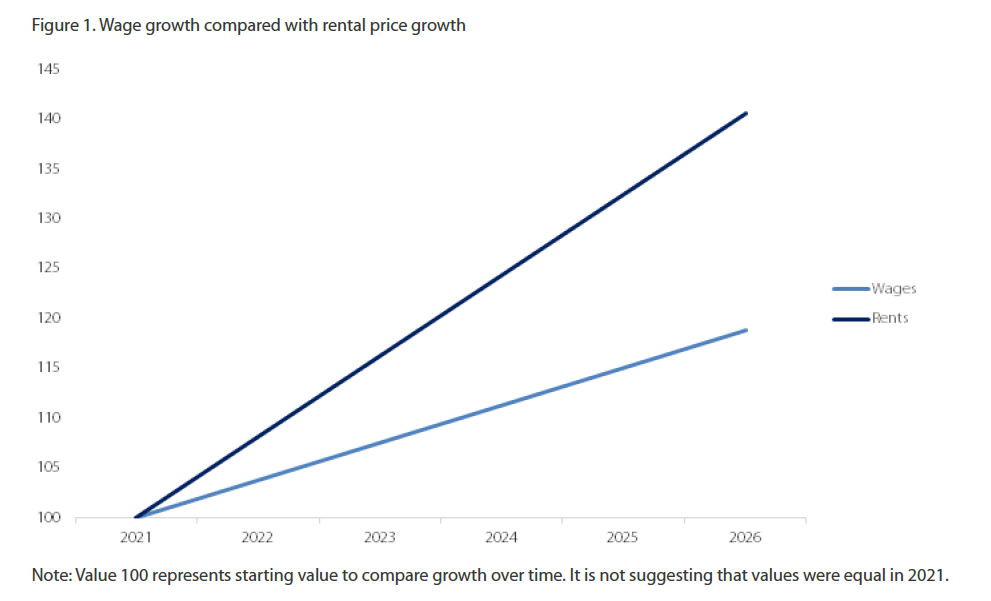
Over the five years between 2021 and 2026, rents have grown at more than twice the rate of wages.
According to Cotality, between July 2021 and 2026 rent prices grew by 40.6 per cent.
In the same period, the cumulative increase in wages according to the Australian Bureau of Statistics was just 18.8 per cent.
Ms Marris said population growth would increase demand for healthcare, education, early childhood services, hospitality and community support.
“But services cannot expand without the people to deliver them,” she said.
“If workers are being pushed further away because they cannot afford local housing, employers face a much harder task recruiting and retaining the workforce the region needs.”
She said moving further from workplaces could also add commuting, fuel and transport costs.
“Housing affordability is becoming part of the employment equation whether we acknowledge it or not,” Ms Marris said.
Nationally, Anglicare’s research found many essential occupations had access to fewer than one per cent of available rentals.
The organisation said affordability had fallen or stagnated for 13 of the 16 occupations surveyed despite wage increases.
Do you have an opinion to share? Submit a Letter to the Editor at Sunshine Coast News via news@sunshinecoastnews.com.au. You must include your name and suburb.
Ms Marris said wage increases alone would not address the problem if housing costs continued to outpace incomes.
“Fair wages are vital, particularly for people doing work that has historically been undervalued,” she said.
“But if rent keeps rising faster than income, workers are always going to be chasing the market.”
Anglicare is calling for greater investment in public and community housing and stronger security for renters.
“More housing is important, but supply alone is not enough if ordinary workers still cannot afford the homes being built,” Ms Marris said.
“If essential workers cannot afford housing on the Sunshine Coast, that eventually becomes a problem for everyone who depends on the services they provide.”