
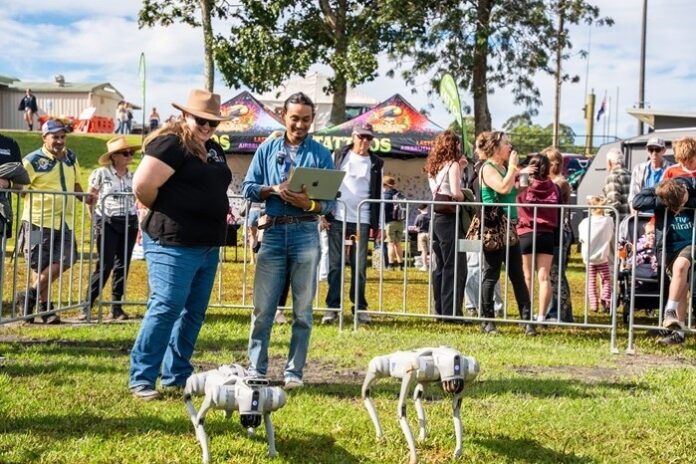
University of the Sunshine Coast students have taught robodogs new tricks, developing a voice-command app that allows the machines to herd sheep under the direction of a human handler.
The upgraded Unitree Go2 robodogs will make their public debut alongside livestock at the Ekka from August 8-16, bringing a Jetsons-style glimpse of the future to Queensland’s largest agricultural show.
The project builds on previous UniSC research that trained robodogs to herd sheep autonomously using cameras, sensors and artificial intelligence.
But project supervisor Dr Erica Mealy said the latest advances came after listening to the people most likely to use the technology.
“Although the robodogs were originally intended to operate autonomously, working-dog handlers gave feedback indicating they wanted to remain in control,” Dr Mealy said.
“Rather than rely solely on automation, this allows a different, user-led experience.
“We wanted the robodog to stop when a handler said ‘stop’, or flank the back of the flock when a handler gave a certain command.
“Just like when we were first approached, the aim here is to assist with a practice which can be costly, labour-intensive and physically demanding.”
UniSC honours student Abdullah al Muhsin said the project centred on a web-based app that lets users issue commands from a phone or laptop.
“The app listens to what you’re saying, recognises specific commands and sends those instructions to the robodog,” Mr al Muhsin said.
The system uses Google Chrome’s built-in speech-recognition technology to recognise commands including “stop”, “away” and “come by”.
Spoken commands are converted into text and transmitted to the robodog via a WebSocket API, where software running on an onboard NVIDIA Jetson computer translates them into movement in real time.
Mr al Muhsin said the software was designed to work with any user rather than being trained to recognise a specific voice.
About 30,000 people a day are expected to watch the UniSC robodogs perform in the Ekka main arena.