
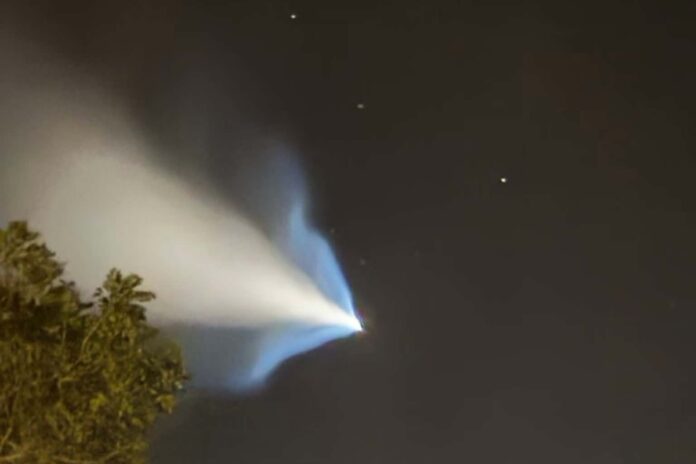
A Chinese rocket has dazzled stargazers on the Sunshine Coast and beyond.
Locals took to social media on Tuesday night to share their experiences, after witnessing the machine’s ascent just before 7pm.
“Wow,” Yvette Elliot said.
“Watched it for a few minutes, very strange,” Sandi Ruen added.
“It seemed to change to an orange colour and then burn out,” Henry Turner said.
Chinese state broadcaster CGTN reported that a modified Zhuque-2 rocket launched from the Dongfeng Commercial Space Innovation Pilot Zone in Gansu Province, carrying the Qianfan DTC-01 and China Mobile-02 satellites. According to the report, both satellites were successfully deployed into orbit.
UniSQ professor (astrophysics) Jonti Horner said the rocket was about 20m tall and able to carry about six tonnes.
“The rocket’s launch path took it above our region, and it released some gases,” he said.
“I’m not sure if it was a second-stage separation or passivation, which is when a rocket is flying at altitude and releases any excess gases.
“That gas expands out into space, condenses and you get vapour turning into solids and ices.”
He explained the colours that appeared.
“Initially people saw a silvery-grey colour, almost white. It then gradually turned red and disappeared. But there wasn’t any real change to the gas itself.”
“The rocket moved from sunlight into the Earth’s shadow.
“It (the perspective from the rocket) was seeing a sunset, so it was lit up by the red light from the sun.
“If it had launched an hour later … without any sunlight to light up the gas … there’d be nothing to see.
“If it had been a couple of hours earlier it would have been daylight here and (the gas would have) probably not been bright enough to see.
“So, it was spectacular for us just because of the time of day.”

Do you have an opinion to share? Submit a Letter to the Editor at Sunshine Coast News via news@sunshinecoastnews.com.au. You must include your name and suburb.
He said it was also relatively unusual to see a rocket above Queensland, but it should become more common.
“Historically, we have not had many launches across our region.”
“There is going to be more … as Chinese companies do more of them.
“We’ve seen images of events like this in the US because of the SpaceX launches there.
“But (in the US) it’s now gone from being a ‘wow, what is that?’ detective story to being just another rocket launch.”
China last month sent an astronaut to its space station for a year, enabling the study of long-duration human physiology in space as Beijing works towards its ambition of a crewed moon landing by 2030.
NASA is seeking to achieve a crewed moon landing in 2028, two years ahead of China.