
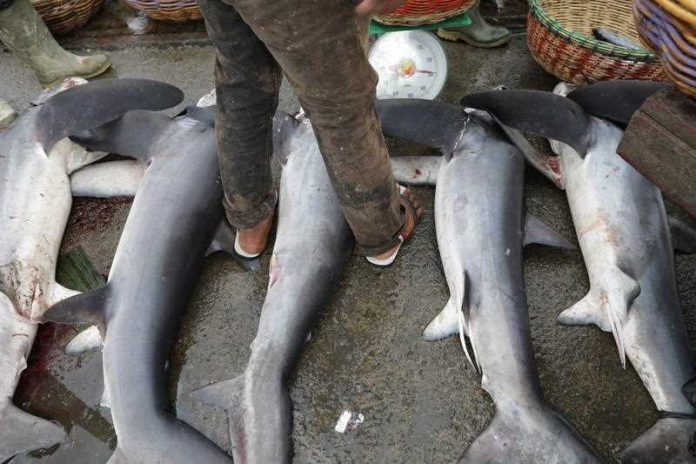
One third of the world’s shark and ray species are at risk of extinction and overfishing is largely to blame, a benchmark global study has warned.
Australian marine biologist Colin Simpfendorfer has spent a lifetime researching sharks and has helped compile the second global report on their prospects.
It’s sobering reading. In the seven years since the first report in 2014, the percentage of shark and ray species threatened with extinction has almost doubled, from 17 to 32 per cent.
“In the latest report we covered 1199 species, with 391 found to be threatened,” Professor Simpfendorfer says.
Overfishing was the universal threat affecting all 391 threatened species. For 262 of them it was the only threat.
Most species of sharks and rays are not intentionally fished, but as bycatch with value they are kept.
In some developing nations, they have become a cheap source of protein in human diets, adding another layer of complexity to the task of conserving them.
“In a country like Australia we can put in a regulation, and say don’t catch this, don’t catch that and we can enforce it well, and it is complied with,” Prof Simpfendorfer says.
“But if you go to a lot of the developing countries where this is a real problem, you don’t have that luxury. There’s a lot more work to do to implement changes in fisheries that will lead to recovery.”
Join an independent local news revolution by subscribing to our free daily news feed: Go to SUBSCRIBE at top of this article to register
The James Cook University professor says many non-government organisations are already heavily involved in sustainable fishing initiatives in developing countries.
“It’s going to take time, but there is hope that we can get there.”
Much rides on the success of that work. If the worst case scenario plays out, and a third of shark and ray species do vanish from the world’s oceans, the consequences for marine ecosystems could be profound.
“Some of these are very important from an ecological perspective, some of them are top apex predators. We would invariably see some quite dramatic changes in marine ecosystems,” Prof Simpfendorfer says.
“It’s very difficult to predict exactly what they would be because these are complex system. There’s been very limited work on that to date.”
Prof Simpfendorfer credits Australia’s well regulated fisheries and catch limits, in particular, with only 12 per cent of local species deemed at risk of disappearing.
But he warned: “We can’t take our eye off the ball. We know how quickly things can change for the worse, sometimes irreversibly.”
A detailed report on the Australian situation is due out later this month.
Behind overfishing, the other global threats to sharks and rays are coastal development (25.8 per cent), agriculture/aquaculture (9.5 per cent), the effects of climate change (10.2 per cent), and pollution (6.9 per cent).
The report is the result of years of work 400 marine life experts around the world who gathered and shared regional data, allowing scientists to build a picture of how individual species are doing.
Prof Simpfendorfer said scientists had access to more data for this year’s report but that did not adequately explain the doubling in at-risk species since 2014.
“Some of the ones we’ve been able to assess for the first time have not come back with good news. But we also have the situation where things have got worse for some species as well.”
At least three species are now deemed “possibly extinct”. They include the Lost Shark that used to inhabit the South China Sea, the Javan sting ray of Indonesia, and a small ray species that once lived in the Red Sea.
“At the moment these are species with limited ranges, in very heavily fished areas. But as fishing increases, it’s affecting more and more species. Unless we do something we’re going to see more disappear.”
The report by Prof Simpfendorfer and his global colleagues has been published in the journal Current Biology.