

A childhood encounter with an aeromedical helicopter set Dr Neeban Balayasoderan on the path to a lifesaving career.
Dr Balayasoderan is one of LifeFlight’s newest retrieval registrars and among 30 doctors preparing to take to the sky to help communities across Queensland and beyond.
“I think my desire to work for LifeFlight started quite a long time ago. I was in the back of the car with my parents when we saw a significant car crash involving a few vehicles,” he said.
“The helicopter landed and the crew came out, including the doctor and paramedic, to help the injured people.
“And by chance, quite a remarkable chance actually, the doctor on board was my cousin.
“I remember being really awestruck by the fact that a healthcare team could come outside of the hospital to the roadside and deliver care to people that needed it there and then.”
Dr Balayasoderan has completed a week of intensive aeromedical training at the LifeFlight Training Academy in Brisbane in preparation for his new role.
He will join Dr Thomas Burgess, Dr Georgina Torlot and Dr David Soutar at the LifeFlight Sunshine Coast base.
The program put the new doctors to the test through clinical scenarios, winching, helicopter underwater escape training (HUET) and sea survival, helping ensure they were rescue ready from day one.
During HUET, the retrieval registrars were taken through multiple scenarios simulating a helicopter crash into water and how to safely exit the aircraft.
LifeFlight HUET manager Mick Dowling said the specialist training gave doctors the necessary skills to work safely on board a helicopter.
“Our mission is to have the doctors skilled with the confidence to be able to deal with any aviation situation that they may be faced with,” he said.
“The common response we get from them after the completion is that it was challenging and uncomfortable, but overall, an amazing experience.
“It’s highly unlikely the aircraft will be required to be ditched into the water; however, all crew are trained should they face that situation.”
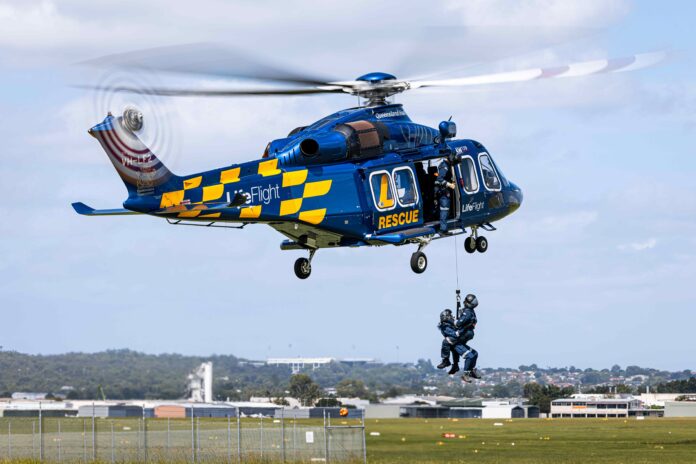
After being tumbled upside down through the water and learning how to survive out on the open water, the doctors were taken through winching procedures.
LifeFlight deputy chief aircrew officer Todd Seymour said the winch training prepared the team for the unpredictability of the role.
“The doctors learn multiple exercises. They learn how to be winched out of the aircraft by themselves, how to be winched out of the aircraft with a rescue crewman or paramedic and learn how to accompany a stretcher into the aircraft,” he said.
“They’re going to remote areas across Queensland and they could be in dense bushland or out to sea off a cruise ship, so it’s important they’re delivered the training they need to perform these roles to a high and safe standard.
“No two days are the same for us at LifeFlight.”
Help keep independent and fair Sunshine Coast news coming by subscribing to our FREE daily news feed. All it requires is your email at the bottom of this article.
The doctors also had their clinical skills pushed to the limit at the Queensland Combined Emergency Services Academy, where they responded to realistic, simulated scenarios including a multi-vehicle collision, while Queensland Fire Department personnel also taught the new recruits how to safely extricate a patient from a road accident.
LifeFlight is the largest employer of aeromedical doctors in the country, with more than 180 medical professionals.
The Sunshine Coast-based aeromedical crew helped 672 people in the past financial year, up 11 per cent on the previous period



