

Scarce, well-serviced Sunshine Coast land needed for housing could instead be taken up by data centres unless clearer planning controls guide where the rapidly expanding facilities are built, the nation’s peak residential building body has warned.
Housing Industry Association’s chief executive, industry and policy Simon Croft told Sunshine Coast News there was legitimate concern about data centres placing additional pressure on land in growth areas such as the Sunshine Coast, where housing and employment developments were already competing for suitable sites.
The warning comes as Sunshine Coast Council confirms it has no plans to introduce specific data centre land-use provisions under its proposed new planning scheme.
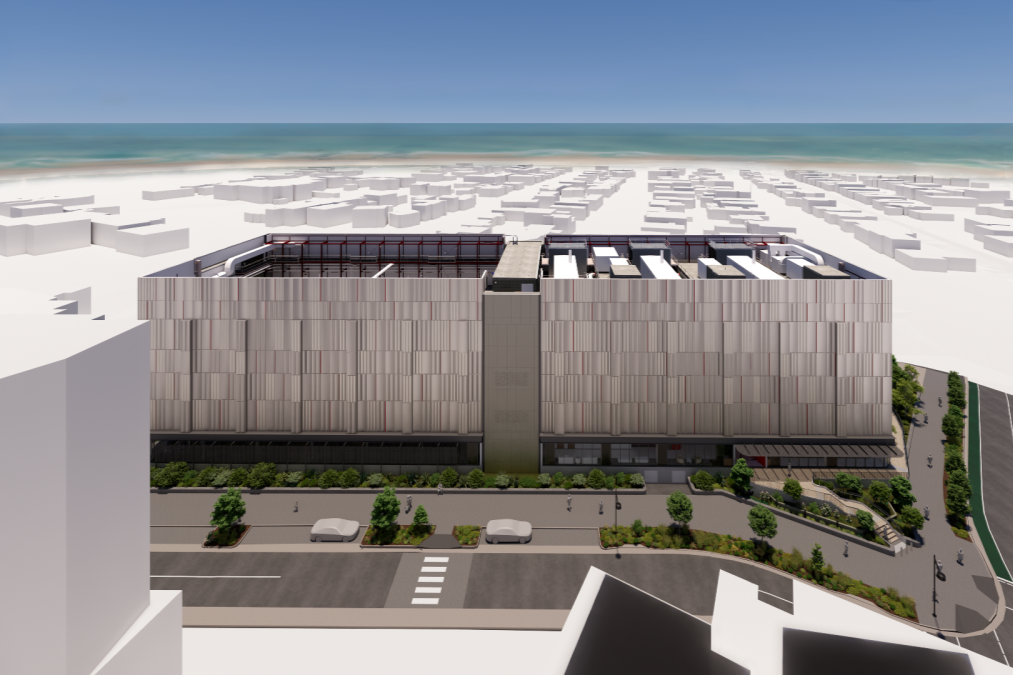
The Sunshine Coast already has one NEXTDC data centre operating in the Maroochydore CBD, with a new $200 million AI-ready facility under construction beside it at 10 South Sea Islander Way.
The five-level SC2 centre, expected to open in the first half of 2027, will adjoin the existing SC1 facility and the international submarine cable landing station.
Mr Croft said the HIA was calling for more strategic guidance around major data-centre developments, including preferred locations, infrastructure expectations, assessment pathways, effects on housing supply and resource consumption.
“The key issue is not whether data centres should be built, but ensuring that their growth does not come at the expense of housing supply and other important critical infrastructure,” Mr Croft said.
“Across Australia, we have already observed instances where land previously identified for residential development has instead been proposed or approved for data centre uses.
“At a time when governments are seeking to increase housing supply and improve affordability, planning decisions should carefully consider the opportunity cost of diverting strategically located land away from housing.”
Mr Croft said data centres also competed for access to critical infrastructure, including electricity, water and transport connections, which were already under pressure in many growing communities.
His comments follow revelations that SC2’s planned computer capacity could use as much electricity each year as about 10,500 typical homes, if operated continuously at full capacity, before power needed for cooling and other building systems was included.
A Sunshine Coast Council spokesperson said under its current planning scheme, data centres were defined as a “research and technology industry” and could be considered for development within the low-impact industry, medium-impact industry and specialised centre zones, where they were subject to code assessment.
However, data centres could also be proposed in other locations through an impact-assessable application, which would require public notification.
The spokesperson said the same broader land-use definition would remain under its proposed new planning scheme, with data centres considered for development within the low-impact industry, industry, specialised centre and innovation zones.
“Sunshine Coast Council recognises the importance of ensuring appropriate assessment of matters such as noise, visual amenity, infrastructure demand, servicing requirements, environmental impacts and the interface with sensitive uses, including residential areas,” the spokesperson said.
“As with all development applications, each application is assessed on its individual merits and in accordance with the relevant legislative requirements.”
The Planning Institute of Australia said Queensland as a whole did not yet have data-centre-specific planning policy, with proposals generally assessed under existing industrial and commercial land-use provisions.
The institute reported the facilities typically required large land parcels in well-located areas close to end users, which could potentially create competition for valuable land and conflicts with nearby residential areas over noise and visual impacts.

Mr Croft said planning frameworks should provide clearer direction on appropriate locations rather than continuing to rely on proposal-by-proposal assessments.
He said smaller facilities could be suitable for business or technology precincts, while larger hyperscale centres were generally better aligned with industrial locations because of their land, energy and servicing requirements.
“Housing growth areas, mixed-use centres and precincts identified for residential intensification should not be unnecessarily displaced by alternative land uses that could reasonably be accommodated elsewhere,” he said.
The growth of the sector could also increase demand for sites with access to major power infrastructure, telecommunications networks and transport connections, placing pressure on land values.
Mr Croft said this could affect the feasibility of housing, industrial and commercial projects, particularly when developers were already contending with infrastructure charges, construction costs, labour shortages and planning delays.
“HIA is concerned that if housing developments are forced to compete for the same limited supply of appropriately serviced land, the result could be fewer homes being delivered or higher costs being passed on to home buyers,” he said.
The South East Queensland Digital Plan, released in April, identifies development of an SEQ Data Centre Strategy as a priority.
The proposed strategy would identify data-centre precincts and land opportunities across the region based on access to water and energy infrastructure and appropriate surrounding land uses.
Mr Croft said the HIA was hopeful the specific strategy would provide certainty for industry, while helping to balance the demands for housing, employment land and supporting infrastructure.
Do you have an opinion to share? Submit a Letter to the Editor at Sunshine Coast News via news@sunshinecoastnews.com.au. You must include your name and suburb.
The Sunshine Coast Council spokesperson said council was aware of discussions at regional and state levels.
“Should a regional strategy proceed, council would participate as a stakeholder and provide local planning and infrastructure input to support outcomes that align with regional planning objectives and local community interests,” the spokesperson said.