
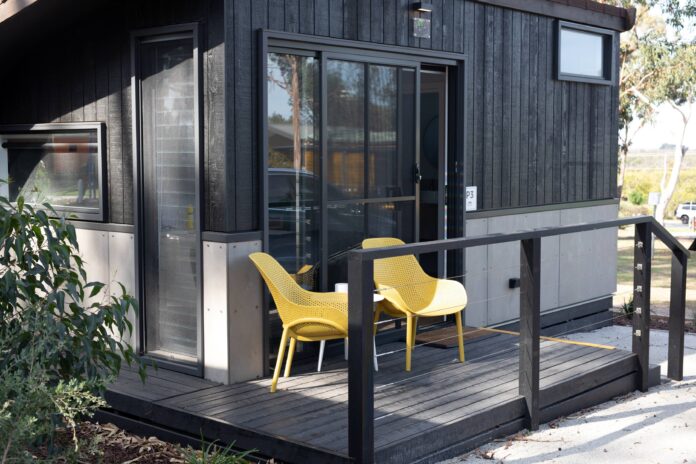
The owner of a tiny home that was erected at his Sunshine Coast acreage has unsuccessfully challenged a ruling against his eligibility for a $25,000 home-building grant.
The Valdora property owner had argued that he met the requirements for the federal government’s HomeBuilder Grant after installing a prefabricated ‘Getaway’ model from Yandina-based Oly Homes on his block.
But the Commissioner of State Revenue ruled the owner was not eligible for the grant, saying the agreement with Oly Homes was not a “comprehensive building contract”.
The owner then applied to the Queensland Civil and Administrative Tribunal to review the decision, with member Richard Oliver on December 1 confirming the commissioner’s decision.
QCAT documents reveal the $126,860 building contract was initially signed in November 2020, with new builds between June 2020 and March 2021 eligible for the $25,000 HomeBuilder Grant.
The acreage block did not have electricity or sewerage, so the property owner engaged a contractor to have power and a sewage treatment plant system installed. That work was not included in the contract with Oly Homes, although the agreement included all internal electrical and plumbing.
The property owner applied for the grant but this was rejected in February 2021, after a review, because it did not qualify as an “eligible transaction” under a government administrative direction.
“A comprehensive home-building contract is defined in the administrative direction to mean a contract under which a builder undertakes to build a home from the start of building work to the point where the home is ready for occupation,” the documents stated.
“The usual indicia of a home includes connected power and plumbing, which must, at a minimum, meet the national requirements prescribed under the National Construction Code, which was not supplied by the builder.”
Help keep independent and fair Sunshine Coast news coming by subscribing to our FREE daily news feed. All it requires is your email at the bottom of this article.
Mr Oliver’s decision points out that connections to utilities are necessarily left out of modular home contracts.
“There is an obvious reason for the exclusions in the Oly Homes contracts. Their specialty is to build modular homes to be located on remote sites prepared by the owner, where power and water services are not available or not readily available,” it said.
“These homes are prefabricated at a factory. When fabricated and ready for delivery they contain all of the necessary items usually found in a house constructed from scratch on site, such as plumbing, electrical fit-out, kitchen cabinetry, wet area fittings, etc. They are ready to be lived in once on site and fixed to the particular foundations, usually it seems, steel posts.
“The contract does not include a contractual obligation to connect electricity or water to the house, that is clearly the owner’s responsibility under the contract’s standard exclusions.”
Mr Oliver’s decision ultimately sided with the decision of the commissioner.
“Because essential electrical and plumbing work was excluded from the contract, I agree with the original decision that the contract is not a comprehensive building contract,” the commissioner said on review.
“It follows the transaction you entered in into is not an eligible home builder transaction … and therefore, you are not entitled to payment of the grant.”