
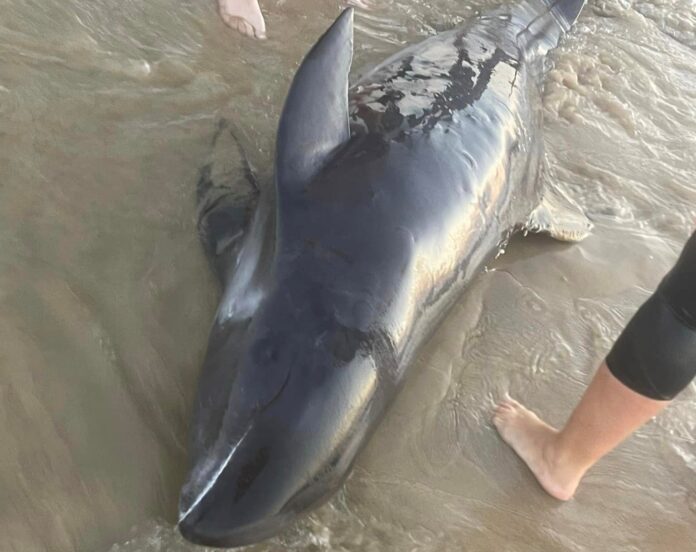
Beachgoers are being urged to keep watch for an injured young melon-headed whale after it washed up on a Coolum beach and was returned to sea.
The whale was discovered by beachgoers early on Tuesday morning, with one woman taking to Facebook to urge others to keep an eye out for it.
She said the whale was rescued twice, with a small group managing to get it back into the sea.
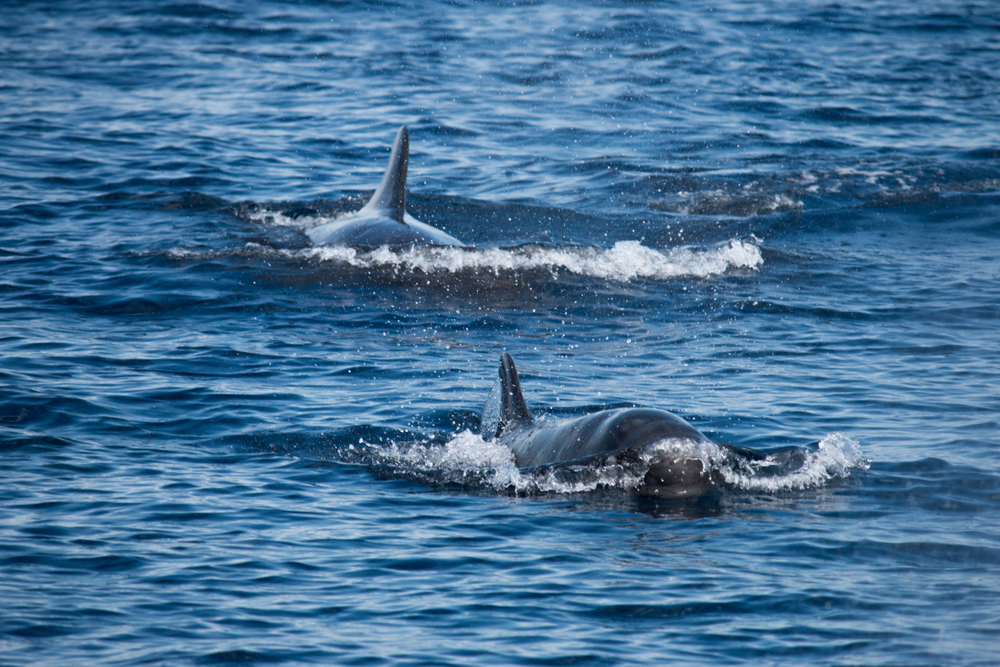
A Department of Environment and Science spokesperson confirmed the young animal was a melon-headed whale, which is actually part of the dolphin family.
Coolum and North Shore Coast Care strandings response member Tash Cassidy said a young whale stranding with injuries was not a usual occurrence.
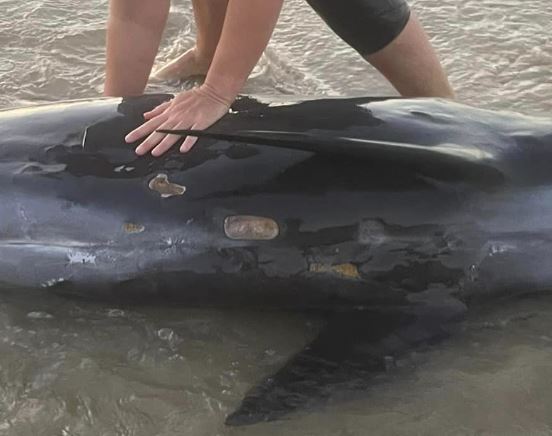
“From the photos, I saw it had some cookie cutter-looking injuries, possibly from a propeller … it did have some slices and some cuts on the dorsal fin as well,” she said.
A DES spokesperson said the sub-adult animal was about two metres long and had minor lacerations on its body, most likely as the result of a shark bite.
“Locals returned the whale to the ocean twice before DES marine park officers arrived,” they said.
“Marine park officers remained on scene, monitoring the ocean throughout the morning, but did not see the melon-headed whale again.
“Marine mammals strand for various reasons, including age, illness and predation. It appears the animal stranded twice due to its injuries, so it may strand again.”
Ms Cassidy said that by the time the incident was called in, the whale had already been returned to sea.
“However, we now have everyone on standby waiting for it to strand again, which is highly likely,” she said.
“It looks very unwell and has injuries. Please keep watch for it if you are on the beach or the water.”
Ms Cassidy said the group that found the whale near Stumers Creek didn’t realise they shouldn’t have tried to get it back in the water.
“If someone finds injured marine life, they should not try to return it to the ocean,” she said.
The woman who posted about the stranding said it was difficult to make contact with animal rescue groups.
“For future reference who do we call at 6am to help injured sea life?” she posted.
“In between trying to keep him wet and comforted we were ringing around trying to call emergency numbers but couldn’t get through to anyone. We even called 000!
“Please keep an eye out as he is injured and will probably resurface.”
Ms Cassidy reminded vessel operators to obey the no-approach laws.
For a whale, the zone surrounds the animal for 100m and extends 300m in front of and behind it. For dolphins, the zone surrounds the animal for 50m and extends 150m in front of and behind it.
The DES spokesperson said the melon-headed whale was not endangered.
“Strandings can occur anywhere along the Queensland coast. Marine mammals can also die at sea and remain unseen by the public,” they said.
“If a marine mammal is stranded in shallow water, be wary of entering the water, particularly if the animal is injured. Sharks may be around or the animal could move and injure you. Look after your own safety first.
“People are advised to stay away from a stranded animal, and not to get close or touch them as they can carry zoonotic diseases, so you should never touch them.
“Queensland Parks and Wildlife Services and local councils have highly trained experts ready to deploy to marine mammal strandings, and it is best to wait for the experts to attend and assist during stranding events.”
To report injured marine wildlife call DES on 1300 130 372, Coolum and North Shore Coast Care on 0478 435 377 or the relevant council.
Scroll down to SUBSCRIBE for our FREE news feed, direct to your inbox daily.