

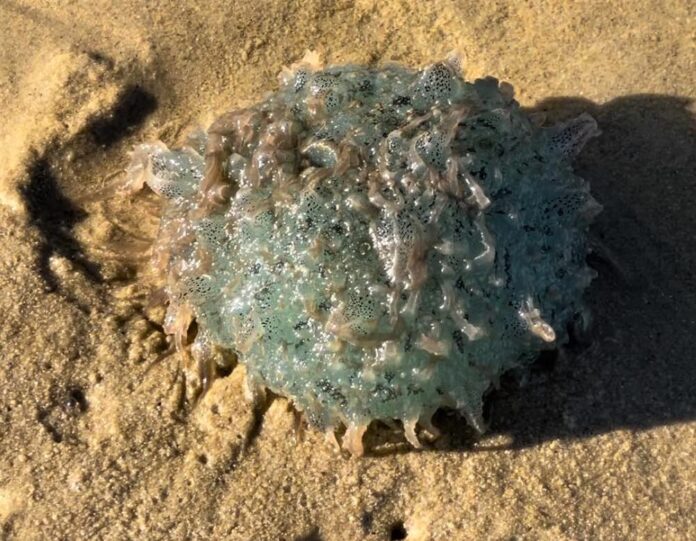
A family’s encounter with a strange sea blob on an outing at a popular beach has revealed a stark danger to dog owners.
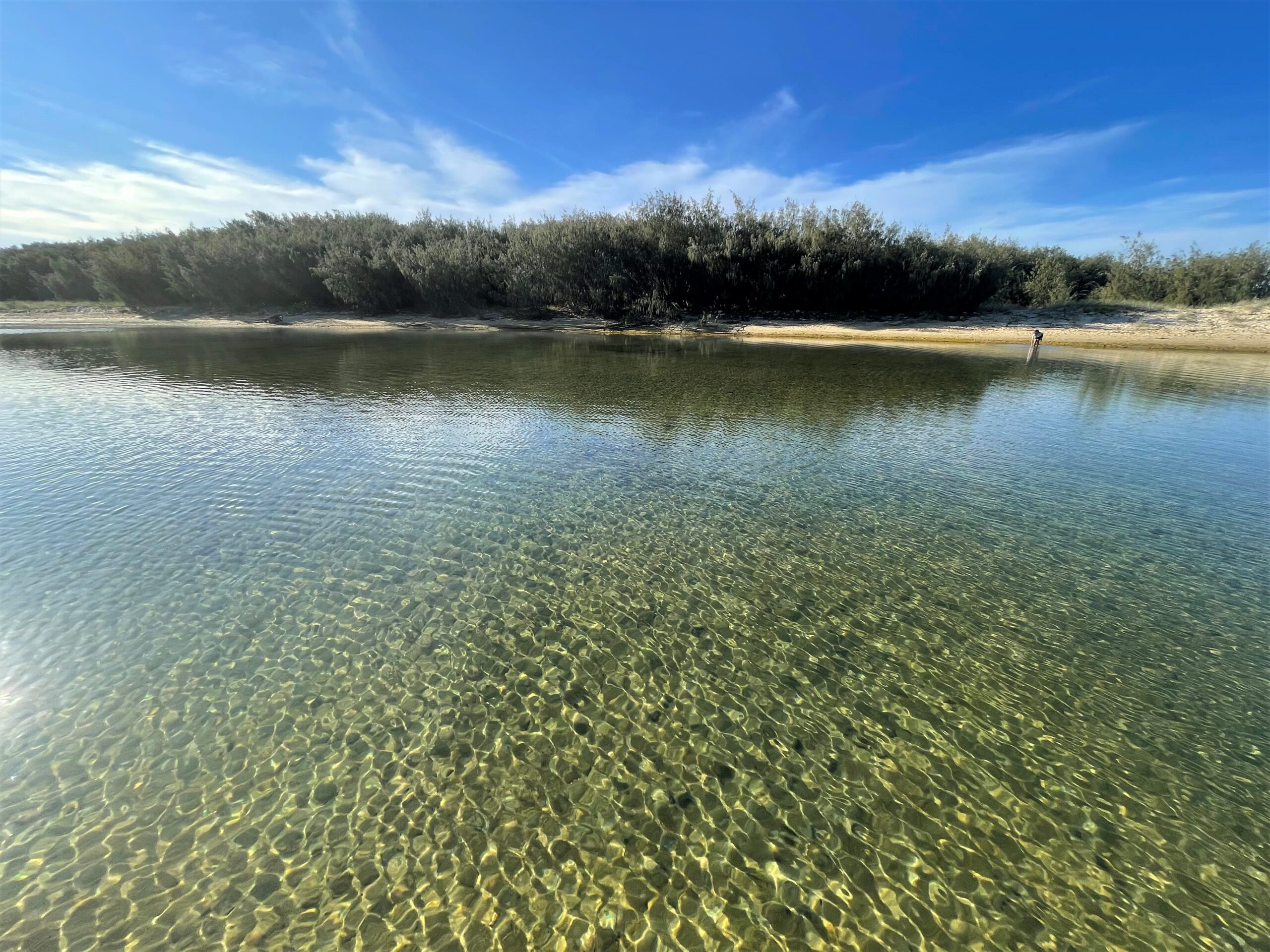
Sheree Peoples and her children were at Maroochy North Shore when her son suddenly rolled something out from the shallows and onto the shore.
“It was a round blue blob with black spots and brown frills or tentacle things,” she said.
“It was about the size of a grapefruit with no flat side, like an upside-down jelly. When it was in the water it looked like it was trying to mimic seaweed, and had an air hole on top.
“Pretty soon a crowd began to gather.”
The family’s discovery last Thursday was a ragged sea hare (Bursatella leachii), two experts confirmed.
After her brother’s find, 12-year-old Kierra Peoples said she saw several of the “slimy” ragged sea hares in the water.
“Everyone was making a fuss over it moving and no one knew what it was,” she said.
“It was just a bit strange, I had never seen anything like it before.
“I saw quite a few in the water but I thought they were coral because they were still.”
Not knowing what the creature was, Ms Peoples gently rolled the blob back into the water.
The Bli Bli resident said her research suggested the ragged sea hare could be harmful to dogs.
“I read they do excrete something from their skin that can be a toxin to dogs, but is fine for a human hand,” she said.
“They are something to be wary of.
“We were near the Mudjimba North Shore and Pincushion Island where a lot of people take their dogs. So be careful with your dogs near the water, in case they do mess with them and get anything in their mouth.
“My son rolled it out with a rock, but he said he did touch it a little bit and it didn’t hurt him.”
Queensland Museum biodiversity collection manager (mollusca) Darryl Potter confirmed several sea hare (or large sea slug) species can be harmful to dogs, if they excessively lick or try to eat them.
“The toxins are derived from the algae or cyanobacteria that the sea slug eats,” he said.
“Dogs may get very sick, or possibly die, so best to keep them away from these creatures if washed up on the beach. Treatment may involve stomach pumping.”
He said ragged sea hares were not considered dangerous to humans unless consumed, in which case they could also make people very sick.
“This is because many species of sea hare have secretions (which are poisonous) that they use to shoot an ink-cloud at potential predators,” he said.
“If you came across one it is best to leave them alone.
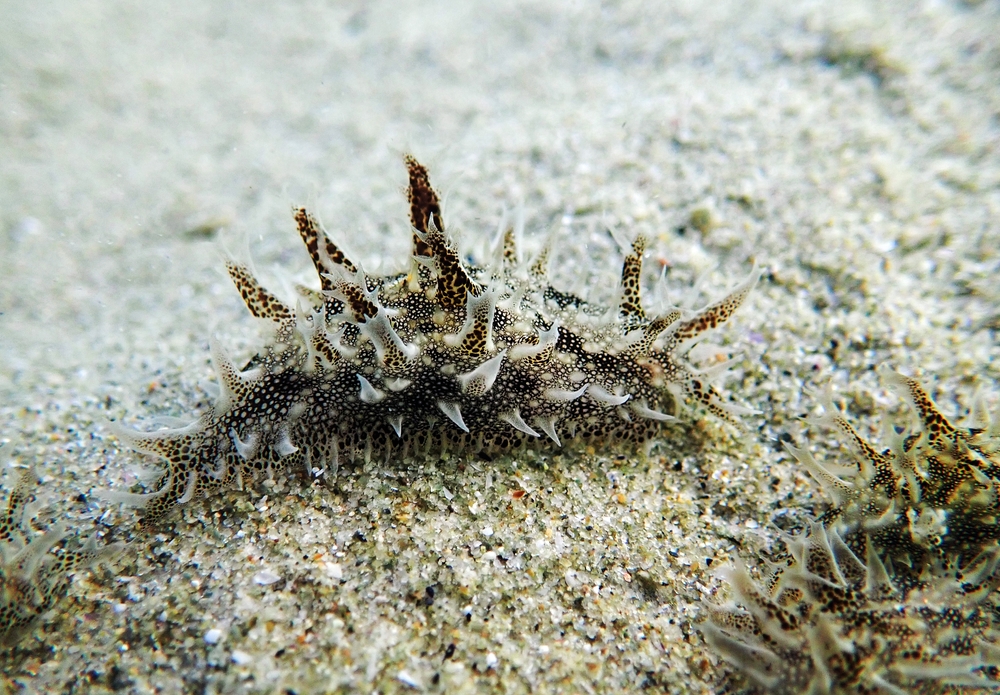
“Just admire them for their beauty as they have an unusual but striking, shaggy appearance, which is particularly noticeable if they are seen swimming in shallow tidal pools.”
He described the sea hare as having “wooliness” about their appearance due to the ragged exterior projections.
“However, when out of the water (which supports them) these extensions are all draped across the body making it difficult to discern the underlying appearance and spots,” he said.
“They can be encountered in protected bays, estuaries and tidal pools intertidally, and down to around a 10-metre depth. They are detritivores, cruising on sand or mud substrates where they graze on algae and cyanobacteria.
“They have wing-like outgrowths (parapodia) at the rear end, and their fleshy body wall (mantle) has finger-like extensions (papillae), which give them a prickly appearance.
“There can also be great variation within and across populations, which is why a number of species and then subspecies were originally proposed for the creature.”
He said they were not always common on the coast but could be at certain times, when eggs (originally laid in ribbons) have hatched and then developed rapidly over two to three months.
“A number of large individuals were sighted near Southport on the Gold Coast a couple of weeks ago,” he said.
“This species of sea slug has a pan-tropical distribution but is absent from the eastern Pacific region.
“Although this species can be found as single individuals, they have often been observed in groups that assemble around sunset and then begin to disperse in the early morning. Copulation is usually in the morning and feeding generally in the afternoon.”
Associate professor Ian Tibbetts from the University of Queensland’s School of Biological Sciences gave some extra facts about the interesting creature.
“Blooms of these things help control lyngbya (blue-green algae), which they feed on,” he said.
“They are pretty cute and do a great job. Because they are a mollusc that lacks a shell, they can grow really fast and then breed really rapidly. This is their life strategy.
“They also have to be immersed to breathe.”
Scroll down to SUBSCRIBE for our FREE news feed, direct to your inbox daily.



