
Hope persists that one of Australia’s most bizarre frogs, which gave birth by vomiting its young, may survive with some help from science.
The extinct southern gastric-brooding frog, which once inhabited the rainforest streams of the Conondale and Blackall ranges, continues to perplex and inspire a new generation of citizen scientists.
On November 23, 1973, Chris Corben, his then-partner Anita Smyth, her sister Debbie and journalist Greg Roberts were young naturalists living in inner-city Brisbane.
In a fish tank they held an unusual frog, which they’d collected from the Conondale region a few weeks earlier.
Mr Corben knew the frog by its scientific name, Rheobatrachus silus.
It was new to science, described only months earlier by David Liem after its discovery the year before at Kondalilla Falls. At that stage, no one knew anything of its extraordinary breeding biology.
Mr Corben decided to move the frog from one aquarium to another. Stressed by the removal of the rocks he’d placed in the tank for shelter, the frog rose to the surface and forcibly ejected from its mouth six tadpoles.
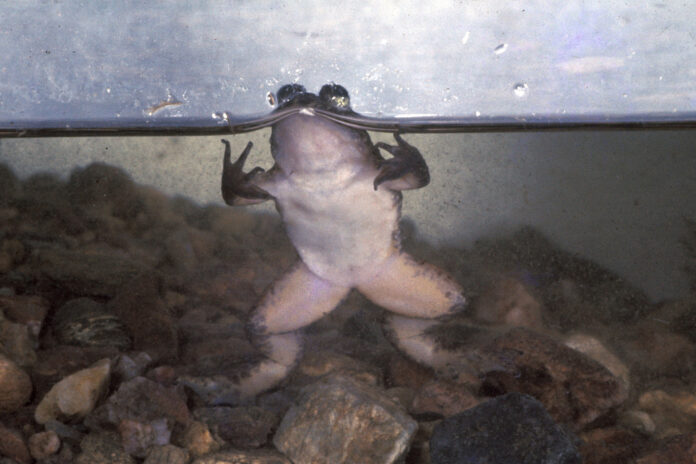
In its new aquarium, the frog hung vertically in the water, with just its eyes and nostrils above the waterline. Viewed through the glass, Mr Corben said the movement of juvenile frogs against the distended abdominal wall could be clearly seen.
On December 13, a decision was made to preserve the frog in the hope of finding the baby frogs in situ.
What happened next was even more dramatic: upon grabbing the frog by its hind legs, it promptly disgorged eight fully-formed frogs. Five more followed within minutes.
Like stories that inform, connect and celebrate the Sunshine Coast? So do we. Join an independent local news revolution by subscribing to our FREE daily news feed at the bottom of this article.
Mr Corben, his friend Glen Ingram and Adelaide herpetologist Mike Tyler wrote up their discovery for the Nature science journal. Nature rejected the submission, convinced it was a hoax.
Eventually their paper was published by the journal, Science, in December 1974.
The early 70s, Dr Ingram notes, was ground zero for the study of frogs in Australia: “Nothing was known! There were no field guides; we had to figure it all out ourselves. No one else was interested.”
The environmental movement was just getting going, too.
Dr Ingram used to house-sit for poet Judith Wright, president of the Wildlife Preservation Society of Queensland.
Soon he, Mr Corben and Mr Roberts would become involved in a vicious fight to save the Conondale area from logging.
The sensation created by the gastric-brooding frog became central to that campaign.
Dr Ingram, then at Queensland Museum, was offered a $20,000 grant to study the frog from the World Wildlife Fund – a lot of money at the time.
But a furious state environment department (then an amalgam of forestry and primary industries) pushed back.
It insisted the museum had no business in ecological research and warned of punishment by the ruling National Party.
Dr Ingram was forbidden from speaking publicly about the frog and conducted his research “in defiance of silence”.
But he had an “in”, via a Lutheran friend who was able to reach the devout Sir Joh Bjelke-Petersen.
Eventually, Dr Ingram was called into a meeting with the then premier.
Sir Joh unexpectedly ordered forestry to investigate the natural values of the Conondale region.
By the early 80s, Mr Corben had been employed to help but there was a problem: the gastric-brooding frogs and several other species had vanished.
Dr Ingram says it wasn’t until around 1990 that “we realised something bad had happened”.
By then, Sir Joh and the National Party had gone. Curiously, it was another politician, an unusually keen environment minister in Wayne Goss’ Labor government named Pat Comben, who sounded the alarm.
Most scientists were unperturbed, as so little was known about the frogs that they simply assumed they would turn up again.
But they didn’t.
The southern gastric-brooding frog (and its cousin, the northern gastric brooding frog, found near Mackay) had fallen victim to chytrid fungus, a pathogen described in 1998 that has devastated amphibian populations worldwide.
It was declared extinct in 2000, having been known in the wild for a mere seven years.
Since then, there have been attempts to resurrect the frog via cloning (the so-called Project Lazarus, which had previously tried to bring back the Thylacine).
And yet like the Thylacine, hope persists.
Jodi Rowley, curator of amphibians and reptiles at the Australian Museum and leader of the FrogID project, says DNA testing is being used in the frog’s old haunts to find proof of life.
“It’s possible,” she says.
“But I’m not holding my breath.”