
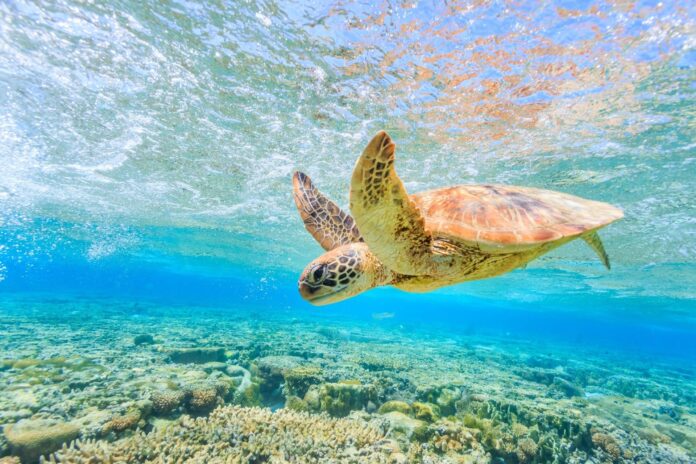
New research conducted by the University of the Sunshine Coast (UniSC) has found that even Australia’s most protected marine habitats are likely to suffer extreme ocean impacts by 2040, increasing threats to thousands of plant and animal species.
The UniSC team found that climate change will mean ocean conditions considered “extreme” today will become “the new normal” in just 15 years.
Even if the Paris Agreement is met, Australia’s marine life will still be under pressure to adapt or move in response to climate pressures, and fast.
Coastal communities can expect to find different marine life occupying their waters by 2040 as climate change extremes of recent years become ‘normalised’.
Even with aggressive cuts to emissions Australia’s ocean conditions will cross a “climate horizon” in the next 15 years and experience sea surface temperatures, ocean acidity, oxygen loss and marine heatwaves outside the ranges experienced in recent millennia.
The UniSC study found marine parks, while protected from industry, were just as exposed to climate pressures as waters outside their boundaries.
The findings follow an alarming 18 months for Australia’s seas, with bleached coral, fish kills and toxic algal blooms linked to marine heatwaves and high ocean temperatures.
Lead author of the UniSC study, Alice Pidd, said the findings had “pretty significant” implications for ocean conservation.
“This new normal and the rapidly changing conditions that we’re seeing reduces the chance for biodiversity to adapt,” she said during a briefing.
“Climate refugia” – marine areas changing slowly as temperatures rise, so more resilient – are projected to vanish under higher-emissions scenarios, with some to remain in the west and south under the “aggressive” emission cuts needed to stay below 2C, the upper limit of the Paris Agreement.
Scroll down to SUBSCRIBE for our FREE news feed, direct to your inbox daily.
Under the scenario closest to the 2.7C warming expected under existing international policy commitments, climate-resilient zones will take a “fairly big hit” and only a few refuges will endure.
“This means that, as we’re tracking now, our marine biodiversity will be under increased pressure to adapt or move, and to do it fairly quickly,” Ms Pidd said.
For fish and other swimmers, adaptation typically involves moving closer to the poles.
The Intergovernmental Panel on Climate Change says this is already occurring at a pace of about 59 kilometres a decade, on average.
Corals, kelp, sea grass and other flora or fauna without fins or tentacles are under the greatest pressures from climate change, as escaping from climate extremes is more difficult.
Co-author UniSC Professor David Schoeman said species with limited opportunities to shift into new habitat, such as those occupying Tasmania’s south or the Gulf of Carpentaria, were also vulnerable.
“In the north, we’re having species being driven by climate change hitting the shore,” he said.
The researchers said the findings should be used to inform the design of future marine parks, such as linking up climate refugia to give marine life the best shot at survival.
Annual international negotiations on climate action are due to take place in November in Brazil.