

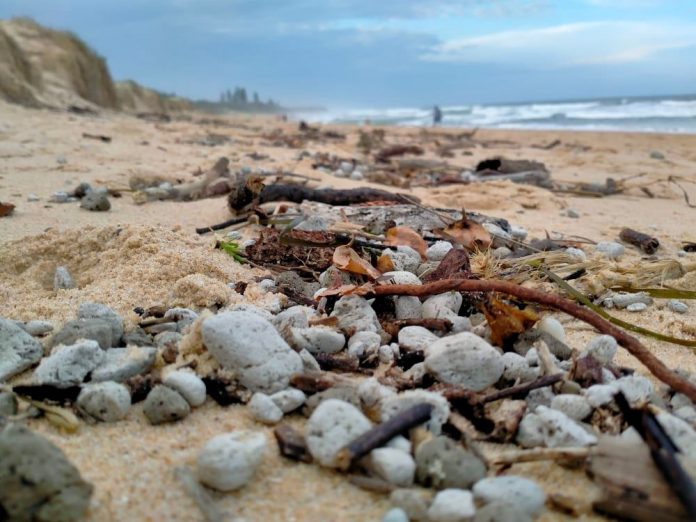
The pumice that has been washing up on our beaches recently has an explosive backstory, but it’s not connected to the Tonga volcano.
Volcanologist Professor Scott Bryan, from QUT, said the mighty eruption of Hunga Tonga–Hunga Haʻapai did not produce a pumice raft which would ordinarily have floated to Australia’s east coast over the following year.
He said the January explosion did not have enough gas in its magma to create the light, bubbly stones capable of drifting vast distances.
Instead, the pumice pebbles that have been lining the Coast’s high tide mark in recent months likely date to four earlier volcanic eruptions in the Pacific between 2001 and 2019.
Professor Bryan said the pumicestones sitting on our shores today would have originally arrived from the volcanoes on the Ring of Fire after successive eruptions in 2001, 2006, 2012 and 2019.
Over the years, the lightweight stones would have been washed up and blown high into the dunes where they have sat.
But because of this summer’s rough weather and beach erosion, those old volcanic rocks have been moved out of the dunes, washed back out to sea before being dumped on the sand again.
“Once the pumice comes ashore it can stay on the shore for quite a long time; the wind blows it high up the beach,” said Prof Bryan.
“It comes ashore, it gets stranded, pushed up to the high tide line. It’s quite light so it can get pushed and blown higher up the beach so it gets protected from the waves.
“Essentially, it can be stored in the back dunes. What we’ve had over the summer is some pretty rough weather and a lot of erosion with strong winds.
“And what’s probably happened is you have had a lot of pumice that has been stored up on the dunes. The king tides and the big waves have eroded into those dunes therefore the pumice has been taken back into the water for a short period of time and then drifted back and is washing up on the beach again.”
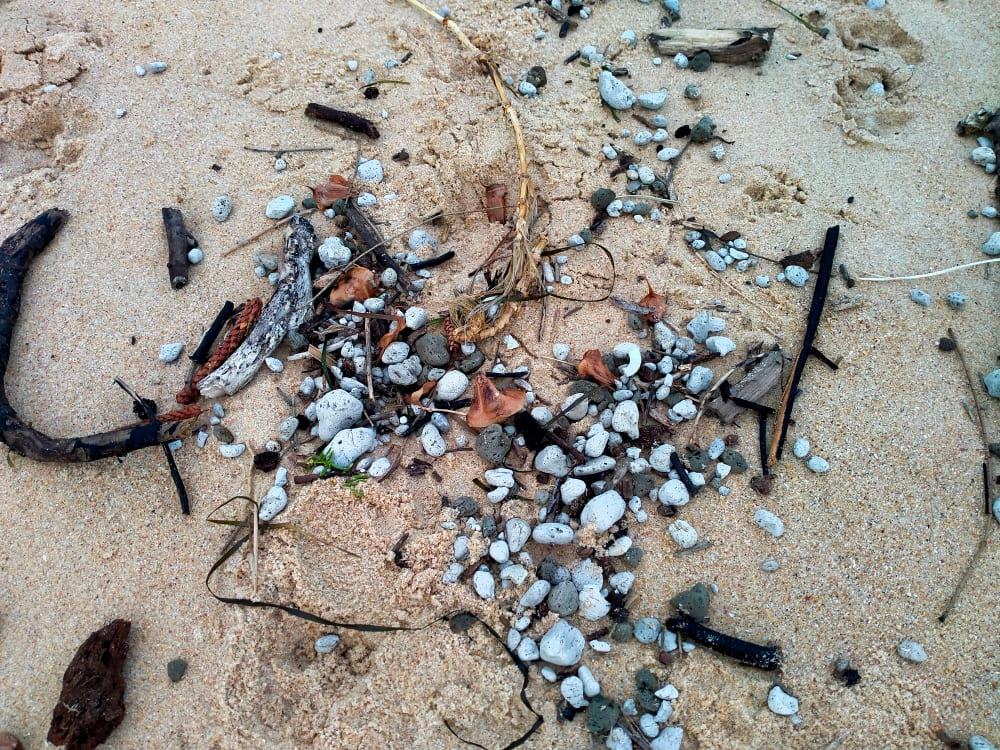
Professor Bryan said the colour of the pumice would help identify from which of the four volcanic explosions it originated.
“If you look at it closely you’ll see there’s two different colours of pumice; there’ll be a whitish to light grey one and the other pumice is a darker grey-greeny browny colour.
“The white-light grey has come from the Havre volcano that erupted in 2012 and that brought a lot of pumice to our shores from 2013 to 2014. It took a long time for it to come in and it came in numerous times over a couple of years.
“The browny-greeny pumice, that’s come from Tonga, and that is probably a combination of at least two or three eruptions.
“We had an eruption in 2001 (volcano F) and pumice came in 2002. Another eruption in 2006 (home reef) and pumice came in 2007 and then we had this eruption in 2019 (volcano F) which brought more pumice in 2020.”
Professor Bryan said the Havre volcano pumice was generally larger fist-size chunks whereas the Tonga volcanoes were much smaller like pebbles.
So next time a wave of pumice washes up on our beaches, how can you distinguish which is from a fresh eruption and which is old news?
Professor Bryan explains that new pumice will usually be covered in up to 100 different species of marine organisms that clasped on while the raft was making the 5000km journey across the vast seas, travelling at about 30km per day.
Like stories that inform, connect and celebrate the Sunshine Coast? So do we. Join an independent local news revolution by subscribing to our free daily news feed: Go to SUBSCRIBE at top of this article to register
The route from the Pacific Islands can take a year, depending on the weather, drifting westwards past Fiji and New Caledonia, across the Coral Sea to Townsville before heading down the East Australian Current.
“What happens is as it drifts west is there are lots of coral reefs, lots of islands where it can pick up a whole range of organisms that would normally live on coral reefs or the coasts of islands,” he said.
“The larvae attach to the pumice and they start to grow and they get transported and brought west and eventually wash up on our coastlines which can be seven to eight months or a year after an eruption.
“So when it first comes in you can’t even recognise it as pumice because it’s just covered in plants and animals.
“There’s algae, barnacles, anemones, corals, molluscs, there’s like 100 or more species found living and growing on the pumice and that’s because it spent all its time out in the warm ocean waters…and picked up all these larvae and they attach and grow and cover the pumice.”
Once on the beach, the stranded stones are stripped clean by the ravages of sand, wind, sun and rain over time.
Although this year’s Tonga eruption did not produce a pumice raft, Professor Bryan said it was possible that debris dragged out to sea by the tsunami could start washing up in Australia months from now.
“There’s not much reporting of debris, but there was a lot of damage and homes washed away so if anything maybe there is debris floating that could wash ashore,” he said.



