
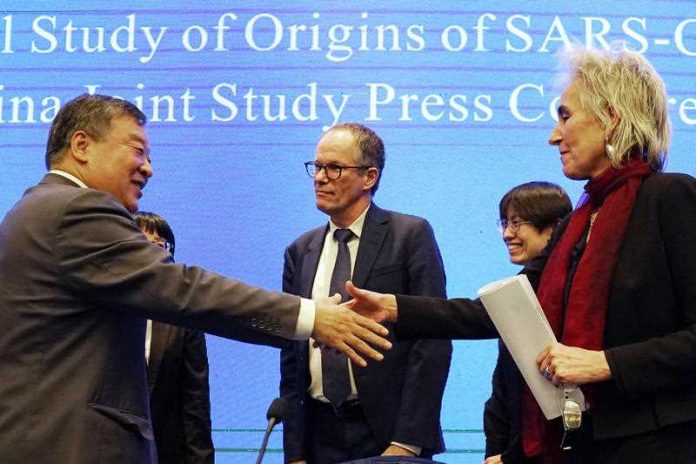
The head of a World Health Organisation-led team probing the origins of COVID-19 says bats remain a potential source and that transmission of the virus via frozen food is a possibility that warrants further investigation but he has rejected a lab leak as unlikely.
Peter Ben Embarek, who led the team of independent experts in its nearly month-long visit to the Chinese city of Wuhan, where the outbreak first emerged at a seafood market in late 2019, said the team’s work had uncovered new information but had not dramatically changed their picture of the outbreak.
“The possible path from whatever original animal species all the way through to the Huanan market could have taken a very long and convoluted path involving also movements across borders,” Mr Embarek told a nearly three-hour media briefing.
Mr Embarek said work to identify the coronavirus’ origins points to a natural reservoir in bats but it is unlikely that they were in Wuhan.
Investigators were also looking for Chinese blood samples that could indicate that the virus was circulating earlier than first thought, he said.
“In trying to understand the picture of December 2019 we embarked on a very detailed and profound search for other cases that may have been missed, cases earlier on in 2019,” he said.
“And the conclusion was we did not find evidence of large outbreaks that could be related to cases of COVID-19 prior to December 2019 in Wuhan or elsewhere.”
The possibility the virus leaked from a lab was extremely unlikely and did not require further study, Mr Embarek said.
Liang Wannian, head of China’s expert panel on the outbreak, said there was evidence of coronavirus infections that could have preceded the first detected case by “several weeks”.
“This suggests that we cannot rule out that it was circulating in other regions and the circulation was unreported,” he told the briefing.
Embarek said the team had identified market vendors selling frozen animal products including farmed wild animals.
“So there is the potential to continue to follow this lead and further look at the supply chain and animals that were supplied to the market,” he said.
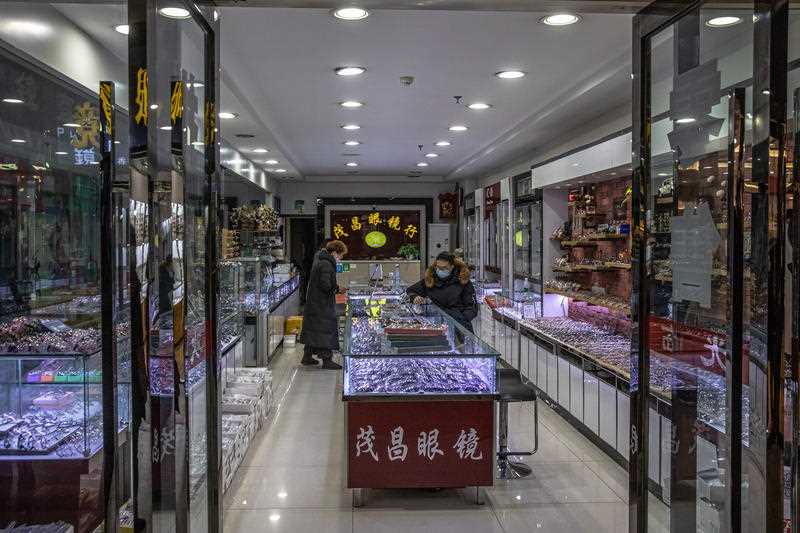
China has pushed the idea that the virus can be transmitted by frozen food and has repeatedly announced findings of coronavirus traces on imported food packaging.
“We know the virus can survive in conditions that are found in these cold, frozen environments but we don’t really understand if the virus can transmit to humans” or under which conditions, Embarek told the briefing.
The team arrived in Wuhan on January 14 and after two weeks of quarantine, visited key sites including the Huanan seafood market, the location of the first known cluster of infections, as well as the Wuhan Institute of Virology, which has been involved in coronavirus research.
Members of the team sought to rein in expectations for the mission, with Australian infectious disease expert Dominic Dwyer saying it would probably take years to fully understand the origins of COVID-19.