
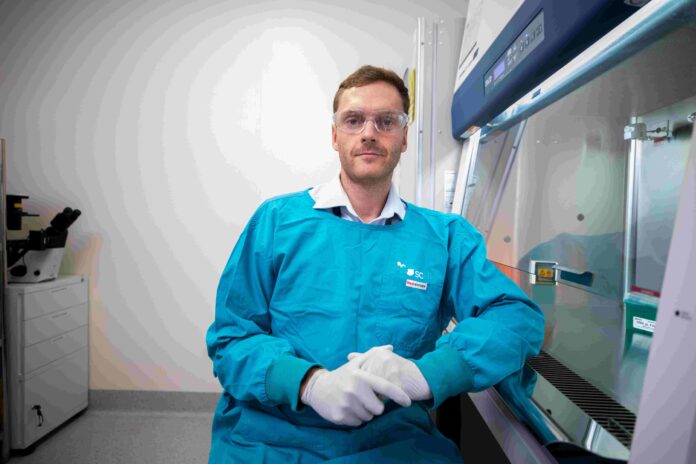
The Sunshine Coast is at the forefront of medical science, with the establishment of a new research hub spearheading advances in the treatment of conditions such as cancer, chronic disease and immune disorders.
Based at the Sunshine Coast Health Institute (SCHI), the Hub for Advanced Spatial Biology Analytics (HASBA) is a partnership between researchers from the University of the Sunshine Coast (UniSC) and Griffith University.
Dr Lochlan Fennell, a computational cancer biologist at UniSC and SCHI, explained that spatial biology works by mapping where cells and molecules are located in relation to one another within an area of the body, and how they communicate.
“People have been using factors like infrastructure, terrain and population density to predict and map things like flood risk and crime for years now. Spatial biology is doing the same thing for the body,” he said.
“In the liver for example, we know cancer has around a 50 percent recurrence rate even after all the cancerous tissue has been removed.
“We’re hoping that by mapping the chemical communication between the apparently healthy liver remaining cells in that area, we can understand both why that is and how we can improve treatments accordingly.”
Scroll down to SUBSCRIBE for our FREE news feed, direct to your inbox daily.
Associate Professor Nicholas West, from Griffith’s Institute for Biomedicine and Glycomics, said spatial biology techniques have transformed understanding of disease processes.
“It’s already revolutionised our treatment of things like melanoma, which used to be a death sentence,” Associate Professor West said.
“Spatial biology presents new opportunities for the development of targeted therapies to improve patient outcomes, however, the complexity and enormity of this new data modality pose significant challenges.”