
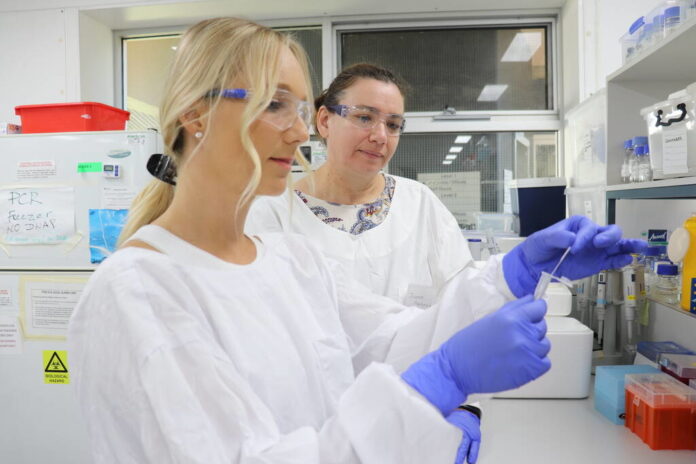
University of the Sunshine Coast researchers have developed a rapid portable test for one of the world’s fastest-spreading mosquito-borne diseases, following funding from the Bill and Melinda Gates Research Foundation.
UniSC associate professor of molecular engineering Dr Joanne Macdonald, who received the Gates Foundation grant of more than $150,000, has had the paper published in Gates Open Research with co-authors Dr Madeeha Ahmed and Dr Nina Pollak.
“We developed a rapid test, with results that look similar to a COVID-19 home stick test, for each of the four types of dengue virus,” she said.
“They were sensitive enough to detect even small amounts of viral genetic material in mosquitoes using only pipettes (tubes) and a heating block, instead of expensive laboratory equipment.
“Our entire testing process took about 35 minutes on the spot, compared to hours of travel time and PCR processing required for current sampling.”
She said the innovative method involved a reagent that inactivated the virus during amplification, enabling simpler, quicker and cheaper detection with a higher level of sensitivity than existing stick tests.
“In practical terms, people and authorities in areas with few resources can set a trap and test mosquitoes each week, to check whether dengue is present.
“It has the potential to make mosquito screening more accessible, enhancing surveillance and control efforts in countries where dengue is endemic.”
The paper was co-authored by researchers from the QIMR Berghofer Medical Research Institute, Queensland Health and the University of Queensland.
It also received funding from the DMTC Medical Countermeasures Program and a UniSC PhD scholarship.
Dr Pollak has since had published a collaborative paper investigating the potential of using the tests to detect dengue in human serum, plasma and blood.
Adding co-authors from UniSC (Dr David McMillan and Malin Olsson), Singapore’s National Environment Agency, National University of Singapore, UQ and industry partner BioCifer, this paper also supported the advantages of the new method.“Our tests provided performance and speed without compromising specificity in human plasma and serum and could become promising tools for the detection of high dengue loads in resource-limited settings,” Dr Pollak said.The research was funded by the DMTC Medical Countermeasures Program and BioCifer.The team’s next goal is to combine each test for the four dengue serotypes into a single test, to further streamline detection.
Dr Ahmed said the tests aimed to lay the groundwork for future studies focused on actual use and effectiveness in the field.“We hope the value of our technology will drive interest among users to conduct field trials in regions where the disease is prevalent,” she said.According to the World Health Organisation, dengue fever is a painful and deadly disease that infects up to 400 million people every year. It is a viral infection that spreads to people from mosquito saliva infected with dengue viruses.There is no treatment other than for relief of symptoms, which include high fever, head and body aches, nausea and rash.
Gates Open Research is a fully open access publishing platform for rapid author-led publication and open peer review of research funded by the Bill and Melinda Gates Foundation.The Bill and Melinda Gates Foundation last year funded 1960 grants worth a total of $10.935 billion to fight poverty, disease and inequity around the world.Dr Macdonald is co-founder and current chief technology officer of medical company BioCifer, which was involved in the research.Gates Open Research is powered by the technology and publishing model of open research publishing services provider F1000.
Like stories about Sunshine Coast people doing great things? Help us deliver more by registering for our FREE daily news feed. All it requires is your name and email at the bottom of this article.