
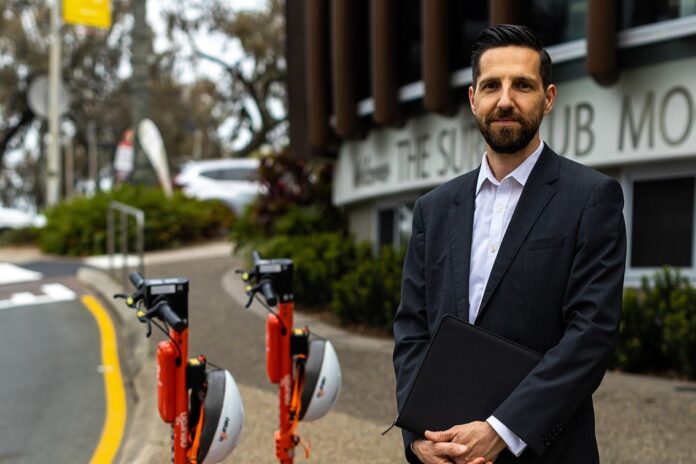
A leading Queensland personal injury lawyer has welcomed sweeping reforms proposed in the state’s parliamentary inquiry into e-mobility safety, but warns riders and pedestrians could still be exposed due to gaps in insurance coverage.
Greg Spinda, partner at Travis Schultz & Partners, said the inquiry provided a comprehensive roadmap for improving safety as the use of e-scooters and e-bikes continues to grow across Queensland.
“The committee should be congratulated. The recommendations are a giant leap forward,” he said.
“If implemented in full we should see improved safety on roads and footpaths and, over time, a better culture of use in the community.”
The report proposes a suite of reforms including banning riders under 16, requiring riders over 16 to hold at least a learner licence, lowering footpath speed limits to 10km/h and giving police stronger powers to seize illegal devices.
Help keep independent and fair Sunshine Coast news coming by subscribing to our FREE daily news feed. All it requires is your email at the bottom of this article.
But Mr Spinda said, from a compensation law perspective, one issue remains unresolved: insurance.
“No recommendation has been made to introduce compulsory third-party insurance for compliant devices.”
“The report recommends that non-compliant devices – such as high-powered or modified scooters – be registered and insured, while compliant, speed-limited devices could still operate in public areas without any compulsory insurance.”
Mr Spinda said this could effectively create a two-tier system where some devices, still very capable of causing injury, remain uninsured.
“We see the fall-out from collisions between these devices and pedestrians or other riders and road users, and even at 10km/h these devices are heavy enough to cause serious harm.”
“Many riders also do not realise they could be personally liable if they cause serious injury. Anyone who seriously harms a pedestrian or another road user, could face legal action directly from the injured person: a very costly and stressful ordeal.”
“That’s why there should be consideration in the near future as to whether compliant devices may require some form of private insurance once suitable products are available.”
Mr Spinda said that while the reforms would likely reduce the risk of severe crashes by limiting speeds and banning illegal modification kits, incidents would still occur.
“When an accident happens – whether it’s a pedestrian struck on a footpath or a rider colliding with a vehicle – the injured person often needs access to rehabilitation, treatment and financial support.
“Without insurance attached to the device, the injured person may have limited avenues to recover compensation.”
Despite this concern, Mr Spinda said the report represented an important step forward.
“I’m a practical person when it comes to law reform. I’d rather see progressive improvements than an all-or-nothing approach while injuries continue to rise.
“The committee has laid out the roadmap: now it’s up to government and parliament to implement the changes quickly before more injuries and deaths occur.”
Mr Spinda said injury data shows younger riders are a high-risk group, highlighting the need for better education for both riders and parents.
“We do see a significant number of injuries involving younger riders, so improving awareness and education around these devices will be critical,” he said.
“These devices are part of modern transport offering more affordable and environmentally friendly alternatives and they are here to stay, but they must be used responsibly, and the community must understand the very real risks that come with them.”