
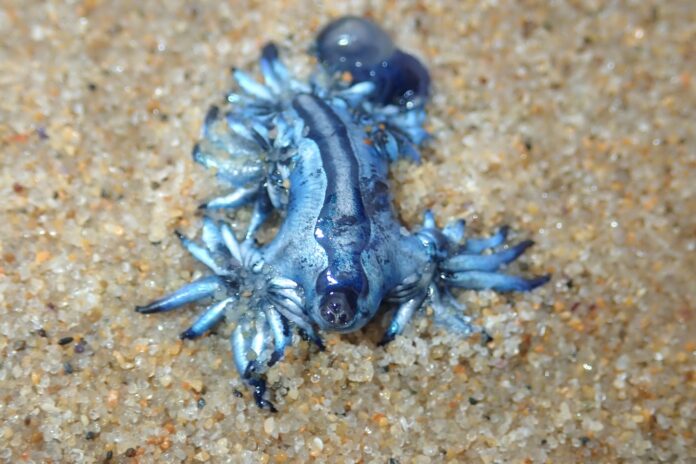
Sunshine Coast beachgoers have been wowed by the sight of some colourful critters that boast some intriguing attributes.
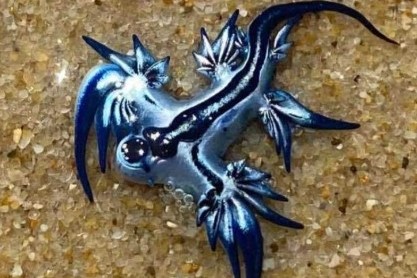
Glaucus atlanticus, also known as blue dragons, have washed onto some local beaches in recent weeks.
They are a type of nudibranch (sea slug) that eat jelly-like creatures including blue bottles, by-the-wind sailors and blue buttons.
Griffith University Professor Kylie Pitt, a marine science expert, said the tiny creatures have some unusual behaviours.
“They’re really weird because, when they eat bluebottles, they actually sequester the stinging cells of the bluebottles,” she said.
“They’ll digest most of the tissue, but they don’t digest the stinging cells.
“Instead, they redistribute the stinging cells to the tips of their appendages.
“So, they have a defence system, acquired from the bluebottle. When an animal (like fish) wants to eat them, the animal gets a mouthful of stinging cells.”
She was unsure if the slugs, which are only about 1cm in length, could sting people.
“They possibly could (but) most people would pick them up with their hands, and the tips of fingers have thick skin so it may not hurt. (But) I tend not to pick them up.”
Want more free local news? Follow Sunshine Coast News on Facebook, LinkedIn and Instagram, and sign up for our FREE daily news email.
Professor Pitt also said the dragons move in a curious way.
“They basically run around upside down on the underside of the water surface, using the surface tension of the water, until they run into a bluebottle or something they want to eat,” she said.
She said the dragons are masters of deception.
“The blue colour is camouflage. When they’re on the underside of the water surface, an animal looking up has a really hard time distinguishing them from the sky and the waves.”
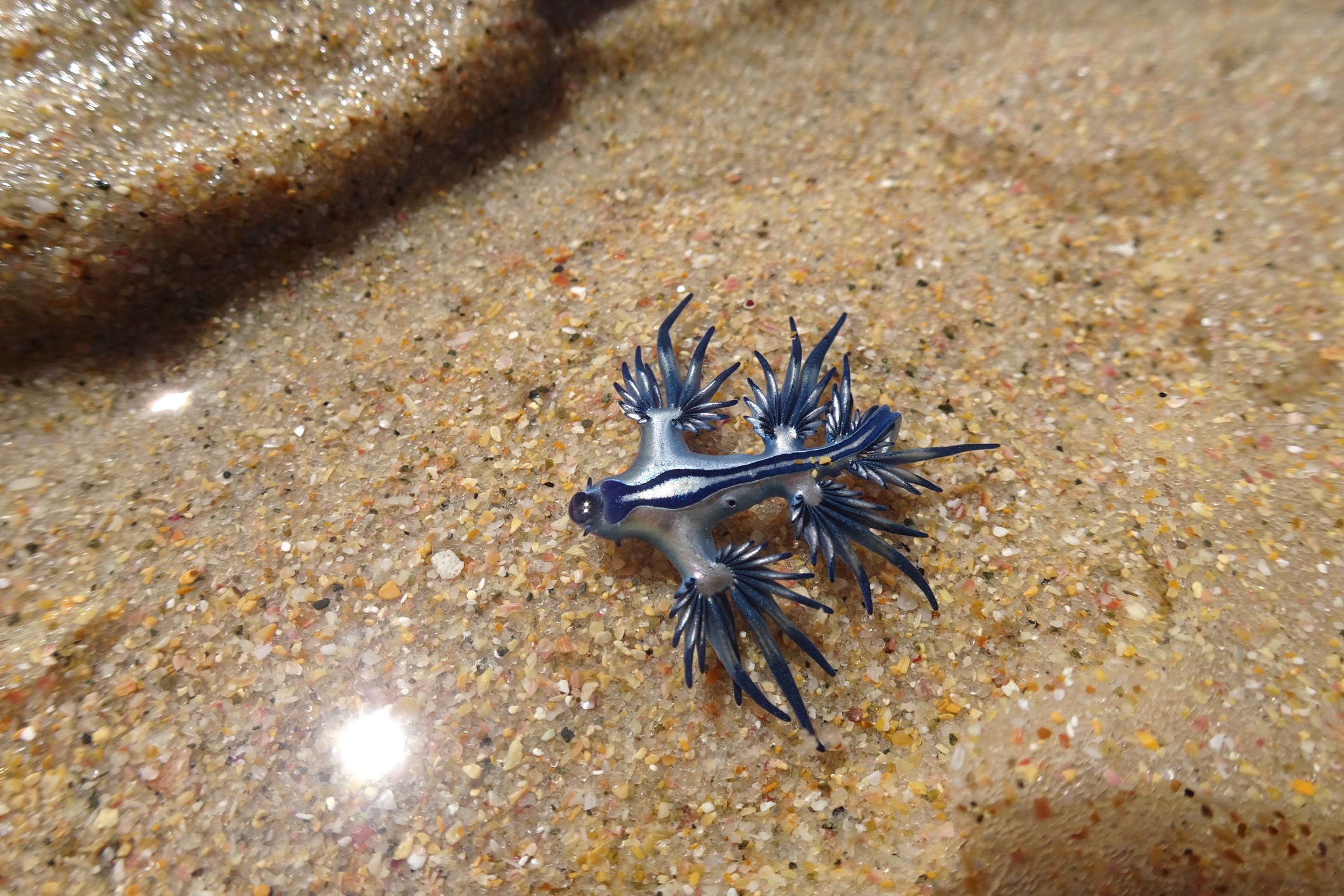
Professor Pitt said blue dragons were relatively easy to find, despite their small size.
“When you see bluebottles, it’s really common to see nudibranch as well,” she said.
“And they (bluebottles and blue dragons) get washed up on to beaches together, when the currents bring them close to shore.”
Beachgoer Ben John Killen was among those to see stranded blue dragons recently.
“Just found these washed up at Bokarina Beach,” he said last month.
Aleesah Darlison was another to see them, in late December.
“Finding the blue glaucus at Bokarina Beach. Do not pick these nudibranchs up,” she said.
“They absorb venom from jellyfish so could be venomous to touch. We used shells to gently scoop them out of the sand, as even the dead ones could cause harm.”
Several people expressed wonder at the creatures.
“Our world is amazing,” Kat Lynn said. “They are so cool to look at,” Ness Charlton said.
“Leave them alone, to avoid skin irritation,” Mathew Lynn added.
“Pretty sure that’s my wife’s earring,” Rodney Duck joked.