
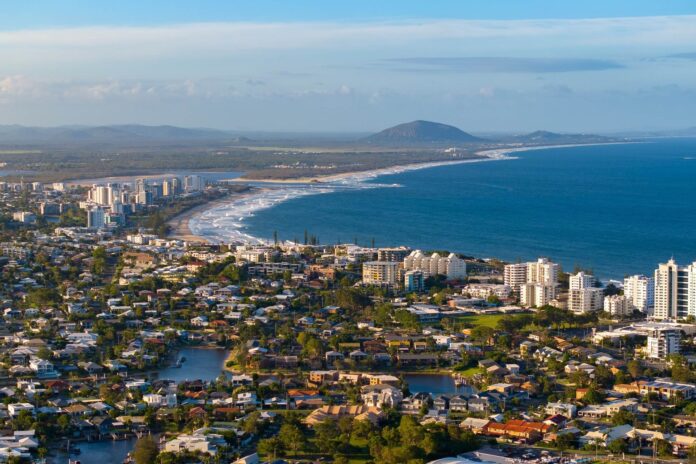
A local MP wants the Sunshine Coast to get a fair go when it comes to delivering road and rail infrastructure, after recent data showed the region remains the top destination for Australians relocating.
The June quarter Regional Movers Index, released this month, shows Australians are increasingly shunning commuter towns and moving to regions with thriving local economies in a shift driven by cost-of-living pressures and the housing squeeze.
Regional migration is sitting at the same level as the tail end of COVID-19 lockdowns, the figures show.
The most popular places to relocate to are outside the commuter belts, with the list topped by the Sunshine Coast for the seventh consecutive quarter.
“Movers (are) increasingly attracted to areas with thriving local economies built on industries such as mining, agriculture, manufacturing, health care and tourism,” the report said.
“The availability and cost of housing are also influencing this broader movement pattern, as movers seek regions where house price growth is slowing or there is some rental availability.”
Do you have an opinion to share? Submit a Letter to the Editor at Sunshine Coast News via news@sunshinecoastnews.com.au. You must include your name and suburb.
The index, compiled by the Regional Australia Institute using Commonwealth Bank data, showed 27 per cent more people moved from the capitals to the regions than in the other direction.
More than 14 per cent of internal migration was to the Sunshine Coast alone. This was nearly 10 per cent more than the Gold Coast and nearly double the next most popular destination, Geelong.
Federal LNP Member for Fisher Andrew Wallace, who previously served as chair of Federal Parliament’s Infrastructure, Transport and Cities Standing Committee, said he wanted more investment and attention on the fast-growing and underserved Sunshine Coast.
“First, Labor stripped $160 million from the Mooloolah River Interchange – one of the country’s worst intersections – after forcing hundreds of locals to relocate in the midst of a housing crisis,” Mr Wallace said.
“Then they cut $7 million from the Caloundra Transport Corridor after a drawn-out consultation – upgrades which would have eased pressure on Caloundra Road and Nicklin Way roundabout and the Caloundra community.
“Now taxpayers are paying double the price for a third of the project when it comes to Sunshine Coast Rail.”
Earlier this month, Federal Minister for Transport Catherine King said the Direct Sunshine Coast Rail Line would “not only revolutionise the way locals move around their region, but unlock new transport opportunities for tourists to visit the Coast as well”, while State Minister for Transport and Main Roads Bart Mellish said it would “help us to manage road congestion as the region grows and encourage more people to use more sustainable and climate friendly transport options”.
The Commonwealth Bank’s head of regional and agribusiness, Paul Fowler, said the research, which had been tracking migration since the height of the pandemic, showed the move away from cities was likely an ongoing structural change.
“Whether you live in the cities or you live in the regions, prosperous, growing regional communities are good for everyone,” he said.

“A more even spread of the Australian population across the country is a stronger setting for overall Australian economic growth.”
Regional areas are predicted to get even bigger as they drive the nation’s energy transition.
Research released by the institute in August showed most communities view renewables as an opportunity but need improved government engagement, housing and health care to succeed.
“The emergence of this new era signifies how important the regions are to the future of our nation,” the institute’s chief executive Liz Ritchie said.
“The regions will be at the heart of Australia’s net zero transition, and it is vital the infrastructure and services our growing regions require are met to ensure long-term prosperity and sustainability of our country.”
Help keep independent and fair Sunshine Coast news coming by subscribing to our FREE daily news feed. All it requires is your name and email at the bottom of this article.