
A NASA rover has streaked through the orange Martian sky and landed on the planet, accomplishing the riskiest step yet in an epic quest to bring back rocks that could answer whether life ever existed on Mars.
Ground controllers at the space agency’s Jet Propulsion Laboratory in Pasadena, California, cheered and exchanged high-fives in triumph – and relief – on receiving confirmation on about 0755 AEDT on Friday that the six-wheeled Perseverance had touched down on the red planet, long a deathtrap for incoming spacecraft.
It took a tension-filled 11-1/2 minutes for the signal to reach earth.
“Touchdown confirmed! Perseverance safely on the surface of Mars, ready to begin seeking signs of past life,” flight controller Swati Mohan announced to back-slapping colleagues wearing masks against the coronavirus.

The landing marks the third visit to Mars in just over a week. Two spacecraft from the United Arab Emirates and China swung into orbit around Mars on successive days last week. All three missions lifted off in July to take advantage of the close alignment of earth and Mars, journeying some 472 million kilometres in nearly seven months.
Perseverance, the biggest, most advanced rover ever sent by NASA, became the ninth spacecraft to successfully land on Mars, every one of them from the US, beginning in the 1970s.
The car-size, plutonium-powered vehicle arrived at Jezero Crater, hitting NASA’s smallest and trickiest target yet: a 5200-hectare strip on an ancient river delta full of pits, cliffs and fields of rock.
Scientists believe that if life ever flourished on Mars, it would have happened three billion to four billion years ago, when water still flowed on the planet.
In the next two years, Percy, as it is nicknamed, will use its two-metre arm to drill down and collect rock samples with possible signs of bygone microscopic life.
Three to four dozen chalk-size samples will be sealed in tubes and set aside on Mars to be retrieved by a fetch rover and brought homeward by another rocket ship. The goal is to get them back to earth as early as 2031.
Scientists hope to answer one of the central questions of theology, philosophy and space exploration.
“Are we alone in this sort of vast cosmic desert, just flying through space, or is life much more common? Does it just emerge whenever and wherever the conditions are ripe?” deputy project scientist Ken Williford said.
“We’re really on the verge of being able to potentially answer these enormous questions.”
China’s spacecraft includes a smaller rover that also will be seeking evidence of life – if it makes it safely down from orbit in May or June.
Perseverance was on its own during the NASA-described “seven minutes of terror” descent.
Flight controllers waited helplessly as the pre-programmed spacecraft hit the thin, 95 per cent carbon dioxide Martian atmosphere at 19,500km/h, or 16 times the speed of sound, slowing as it plummeted.
It released its parachute, jettisoned its heat shield, and then used a rocket-steered platform known as a sky crane to lower the rover the final 20m to the surface.
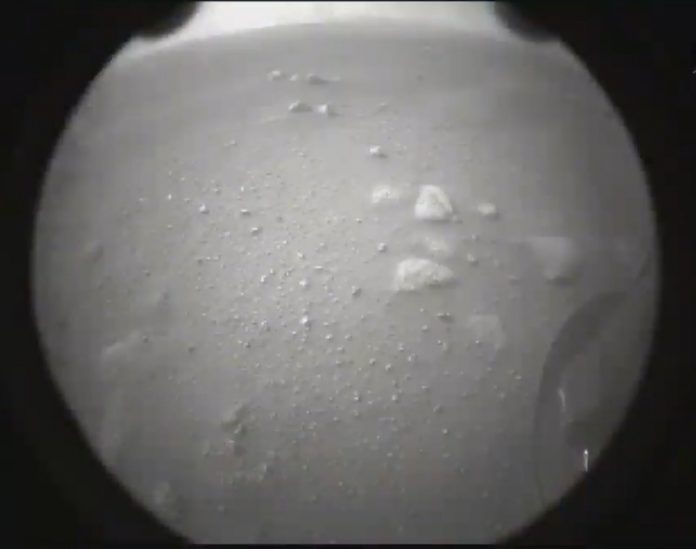
Perseverance promptly sent back a grainy, black-and-white photo of Mars’ pockmarked surface, the rover’s shadow visible in the frame. The rover appeared to have touched down about 30m from the nearest rocks.
NASA is teaming up with the European Space Agency to bring the rocks home. Perseverance’s mission alone costs nearly $US3 billion ($3.9 billion)