

Spacecraft from the United States, the United Arab Emirates and China are approaching Mars this month.
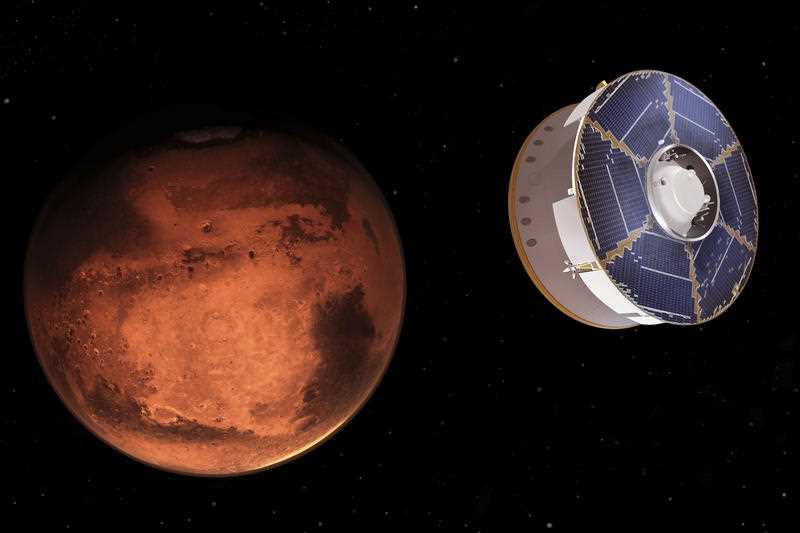
After hurtling hundreds of millions of kilometres through space since July last year, three robotic explorers are ready to hit the brakes at Mars.
The stakes – and anxiety – are sky high.
The United Arab Emirates’ orbiter (pictured above) reaches Mars on Tuesday followed less than 24 hours later by China’s orbiter-rover combo.
A US-built rover will arrive on the scene a week later, on February 18, to collect rocks for return to earth – a key step in determining whether life ever existed at Mars.
Both the UAE and China are newcomers on Mars, where more than half of earth’s emissaries have failed.
China’s first Mars mission, a joint effort with Russia in 2011, never made it past earth’s orbit.
“We are quite excited as engineers and scientists, at the same time quite stressed and happy, worried, scared,” said Omran Sharaf, project manager for the UAE.
All three spacecraft rocketed away within days of one another last July, during an earth-to-Mars launch window that occurs only every two years.
That’s why their arrivals are also close together.
Called Amal, or Hope in Arabic, the Gulf country’s spacecraft is seeking an especially high orbit – 22,000km by 44,000km – all the better to monitor the Martian weather.
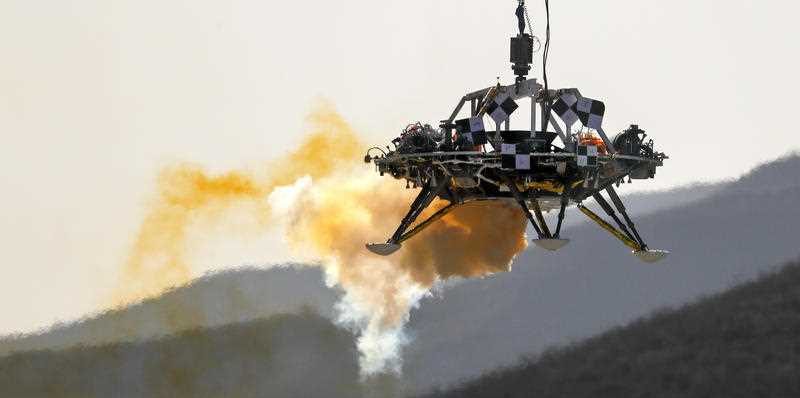
China’s duo – called Tianwen-1 or “Quest for Heavenly Truth” – will remain paired in orbit until May, when the rover separates to descend to the dusty surface.
If all goes well, it will be only the second country to successfully land on the red planet.
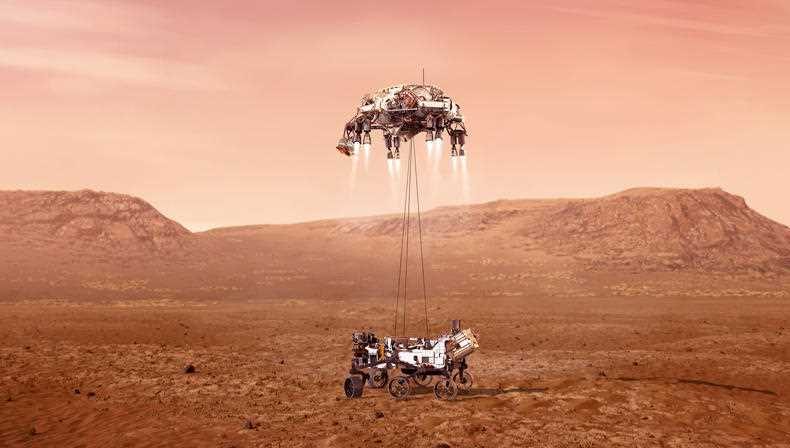
The US rover Perseverance, by contrast, will dive in straight away for a harrowing touchdown similar to the Curiosity rover’s grand Martian entrance in 2012.
Despite their differences – the one-tonne Perseverance is larger and more elaborate than the Tianwen-1 rover – both will prowl for signs of ancient microscopic life.
Perseverance’s $US3 billion ($3.9 billion) mission is the first leg in a US-European effort to bring Mars samples to barth in the next decade.
Faster than previous Mars vehicles but still moving at a glacial pace, the six-wheeled Perseverance will drive across JezeroCrater collecting core samples of the most enticing rocks and gravel.
The rover will set the samples aside for retrieval by a fetch rover launching in 2026.
Under an elaborate plan still being worked out by NASA and the European Space Agency, the geologic treasure would arrive on earth in the early 2030s.
Scientists contend it is the only way to ascertain whether life flourished on a wet, watery Mars 3 billion to 4 billion years ago.
NASA’s science mission chief, Thomas Zurbuchen, considers it “one of the hardest things ever done by humanity and certainly in space science”.
The US is still the only country to successfully land on Mars, beginning with the 1976 Vikings.
Two spacecraft are still active on the surface: Curiosity and InSight.
Smashed Russian and European spacecraft litter the Martian landscape, meanwhile, along with NASA’s failed Mars Polar Lander from 1999.
Six spacecraft currently are operating around Mars: three from the US, two from Europe and one from India.
The UAE hopes to make it seven with its $US200 million mission.
The China Academy of Space Technology’s Ye Peijian noted that Tianwen-1 has three objectives: orbiting the planet, landing and releasing the rover.
If successful, he said in a statement “it will become the world’s first Mars expedition accomplishing all three goals with one probe”.